
- Chennai
- Tamil Nadu
- India
- World
- EntertainmentEntertainment
- Business
- Sports
- Lifestyle
- Technology
- Videos
- Explainers
- Editor's Picks
KOLKATA: Close to 90 per cent of the 3.60 crore electors turned up to vote in the first phase of the West Bengal Assembly polls till 5 pm on Thursday, held under the shadow of large-scale name deletions under the SIR exercise, sporadic violence and assault on at least three candidates.
The voter turnout is among the highest in recent electoral history of the state.
Polling in 16 districts began at 7 am on Thursday amid tight security to decide the electoral fate of 1,478 candidates, including 167 women, in 152 constituencies of the 294-strong state Assembly.
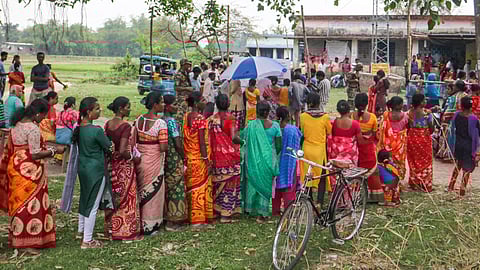
Long queues outside polling booths reflected strong voter participation in what is being seen as a crucial round in a high-stakes contest between the ruling Trinamool Congress (TMC) and the BJP.

The state recorded 89.93 per cent voter turnout till 5 pm, with the Dakshin Dinajpur district leading with 93.12 per cent polling. With voting slated to continue till 6 pm, political observers said the turnout might cross 95 per cent.
Analysts say the turnout reflects both heightened political mobilisation and the statistical impact of the Special Intensive Revision (SIR), which pruned over 91 lakh names from the voter's list across the state.
The steady climb, from 18.76 per cent in the first two hours to 41.11 per cent by 11 am and 62.18 per cent by 1 pm, underscored a strong voter response across geographies -- from the tea gardens of North Bengal to the communally sensitive belts of Murshidabad and the politically volatile Jangalmahal.
Many of the districts that voted in the first phase had seen significantly higher turnouts in the 2021 Assembly elections when polling was held in eight phases.
The SIR exercise, which shrank the electorate by nearly 12 per cent, loomed large over the phase. While the Election Commission has maintained that the revision improved the accuracy of the rolls, opposition parties, particularly the TMC, have alleged large-scale disenfranchisement, turning turnout itself into a contested political statistic.
That tension spilled onto the ground in multiple districts.
Clashes, allegations of intimidation and attacks on candidates, including on two of the BJP, were reported from several constituencies, prompting the Election Commission to seek detailed reports even as it maintained that polling was "largely peaceful".
In Birbhum's Khoyrasol, tension escalated dramatically in the final hours after voters alleged that votes cast in favour of the TMC were being registered for the BJP. This triggered protests, a temporary halt in voting and clashes between locals and security personnel.
Eyewitnesses said the situation spiralled following an argument between polling officials and voters, with locals gathering outside the booth and staging a protest. While forces intervened to disperse the crowd, stone pelting was reported later, and security personnel resorted to mild force.
Earlier in the day, BJP candidate Suvendu Sarkar was allegedly manhandled in Dakshin Dinajpur's Kumarganj, while BJP MLA Agnimitra Paul's car was attacked in Asansol Dakshin, with stones shattering its rear windowpanes -- incidents the party cited as evidence of "targeted violence".
The TMC denied the allegations, accusing the BJP of attempting to "engineer" unrest.
Tension escalated further in Naoda when stones were allegedly hurled at the convoy of AJUP chief Humayun Kabir during his visit to a polling area, forcing security personnel to intervene. The incident triggered a brief flare-up, adding to the volatility in the constituency.
Clashes erupted between supporters of the TMC and the Aam Janata Unnayan Party (AJUP), leading to a baton charge by central forces.
Meanwhile, in Birbhum's Labhpur and Malda's Chanchal, BJP polling agents were allegedly assaulted by the TMC.
In Murarai, clashes between Congress and TMC workers left at least two injured. In Domkal, allegations surfaced that voters were prevented from reaching booths, necessitating a security escort.
The Election Commission, facing mounting pressure, reported receiving around 500 complaints by noon, with another 375 through the cVIGIL app. The TMC alone claimed to have lodged over 700 complaints by mid-afternoon, many related to alleged EVM malfunction and the conduct of central forces.
The EVM issue added another layer of political contestation to an already polarised phase where identity, citizenship, and the fallout of voter list revision have overtaken traditional issues like jobs and corruption.
Leader of the Opposition Suvendu Adhikari alleged that "TMC-sheltered criminals" were intimidating voters, while the TMC accused the BJP of using central agencies and forces to influence the electoral process.
District-wise data showed Dakshin Dinajpur recording the highest turnout of over 81 per cent, followed by Murshidabad at around 91 per cent, and Bankura and Cooch Behar, 92 per cent each.
The voter turnout was around 90 per cent in Malda, Jhargram and Paschim Medinipur, while Kalimpong recorded around 81 per cent polling.
The first phase, covering all 54 seats in North Bengal along with key constituencies in South Bengal, is central to the BJP's strategy of consolidating its northern stronghold, where it had surged in 2019 and remained competitive in 2021, and to the TMC's effort to blunt that expansion early in the contest.
In 2021, the BJP had won 59 of these 152 seats against the TMC's 93.