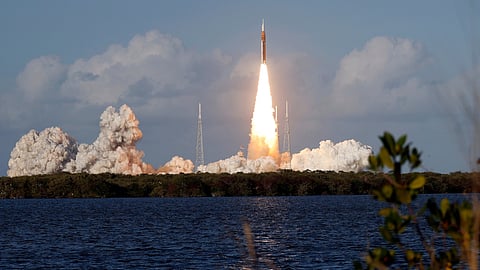

CAPE CANAVERAL: The four astronauts aboard the Artemis II have reached orbit. They will circle the Earth for about 25 hours before catapulting toward the moon.
The four astronauts embarked on the high-stakes flight around the moon Wednesday, humanity's first lunar voyage in more than half a century and the thrilling lead-off in NASA's push toward a landing in two years.
Artemis II commander Reid Wiseman led the charge into space with “Let's go to the moon!” accompanied by pilot Victor Glover, Christina Koch and Canada's Jeremy Hansen. It was the most diverse lunar crew ever with the first woman, person of color and non-US citizen riding in NASA's new Orion capsule.
They'll hurtle several thousand miles beyond the moon, hang a U-turn and then come straight back. No circling around the moon, no stopping for a moonwalk — just a quick out-and-back lasting less than 10 days. NASA promises more boot prints in the gray lunar dust, but not before a couple practice missions.
Artemis II is the opening shot of NASA's grand plans for a permanent moon base. The space program is aiming for a moon landing near the lunar south pole in 2028

Mission Control's communication link with the orbiting capsule cut out after switching from one tracking and data relay satellite to another. But the problem was quickly resolved by resetting ground equipment.
An hour into the flight, the upper stage boosted the Orion capsule, Integrity, and its crew into a higher orbit around Earth.
“The sun is rising on Integrity,” Wiseman radioed.
Koch, meanwhile, had an extremely important job: Getting the toilet working.
Koch ran into trouble with the toilet, seconds after starting it up.
“The toilet shut down on its own, and I have a blinking amber fault light,” she told Mission Control. She was advised to use a handheld bag-and-funnel system for now — CCU, short for Collapsible Contingency Urinal — while flight controllers pondered how best to deal with the so-called lunar loo.
The toilet is located in the “floor” of the capsule, with a door and curtain for privacy. It's an upgraded version of an experimental toilet that launched to the International Space Station in 2020. That station toilet is currently out of order; two others are working fine.
The four astronauts will be sticking close to home for the next day or so, checking out the capsule in orbit around Earth.
The upper stage of the rocket will separate, and the crew will manually fly the Orion capsule toward it to practice docking, preparing for future missions to the moon's surface.
Tomorrow night they will fire Orion's main engine to escape Earth's gravity and head for the moon, 248,000 miles away.
Five minutes into humanity's first flight to the moon in 53 years, Commander Reid Wiseman saw the team's target: “We have a beautiful moonrise, we're headed right at it,” he said from the capsule.