
- Chennai
- Tamil Nadu
- India
- World
- EntertainmentEntertainment
- Business
- Sports
- Lifestyle
- Technology
- Videos
- Explainers
- Editor's Picks
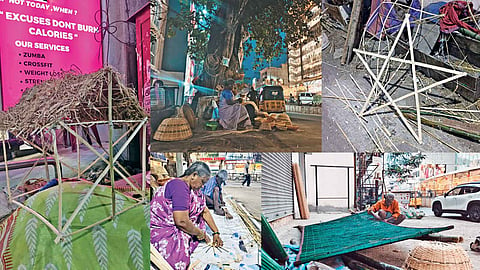
CHENNAI: Towards the end of the Doveton flyover in Purasawalkam High Road, a group of basket weavers are seen making bamboo baskets, stars, oil bottles and other artefacts. Upon enquiry, we learn that over 20 families depend on bamboo basket weaving for low income, as rising raw material costs and uncertain sales have forced younger generations to move away from the craft.
Rajammal, a weaver who runs a roadside shop with her husband, has been engaged in this craft for nearly 60 years. The skill was passed down to her through generations. She makes a wide range of bamboo products, including food baskets for weddings, flower baskets, and oil bottles. The couple work from 10 am to 10 pm every day.
Explaining the sourcing and cost of raw materials, Rajammal says, “The bamboo is sourced from Andhra Pradesh and delivered by truck. The transport cost is much higher than the cost of the bamboo itself. We have to hire an auto for Rs 500 to Rs 700 to bring it to our shop. We get materials twice a week.”
Despite the long working hours, the income remains low.
We spend Rs 500 to Rs 1,000 a day for weaving these baskets, but we make only Rs 100 to a maximum of Rs 200. This not only burns a hole in our pocket but hardly pays for our bread and butter. For emergencies and major expenses, we have to borrow money from loan sharks
Rajammal
Rajammal’s three children have taken up other daily wage jobs but continue to help their parents at the shop. “More than business, this is tradition, and I hope to pass it on to my grandchildren, but the younger generation looks for more stable employment,” she shares.
Speaking about her clients, the weaver states, “Some customers buy at the price I quote, while others bargain. Big shops nearby don’t affect my business because what I sell is different. Many people stop to look at my products and then walk away, so sales are not steady.”
Despite the lack of profit, Rajammal continues the work out of a deep sense of cultural attachment. “This is our tradition and our culture. I cannot quit doing this just because the income is unstable. Rain affects our sales because wet bamboo loses its colour. Some days we don’t sell anything, but I return the next day. That is a part of this business,” she notes.
During the festive season, the family makes special products. “For Christmas, we made hut sets with figures and sold each set for Rs 100. Making stars for the New Year has been a tradition since my grandfather’s time,” she tells us.
Recounting the hardships they faced, Rajammal says, “I took a government loan of Rs 10,000 for street vendors, with a monthly repayment of Rs 900, but that scheme is no longer available. Earlier, the police used to chase us away, but now they are more cooperative.”
Another bamboo basket shop nearby is run by Gowri and her husband, Anandan, who have been weaving baskets for nearly 30 years. The craft was passed down from Gowri’s mother, who had been in the profession for decades. Gowri began weaving at the age of 25, after her children started school. Until then, her husband handled the weaving while she managed the household.
Despite the low income, they continue the work as a family legacy. However, they have chosen not to teach the craft to their children. “We don’t want them to face the hardships of working outdoors, especially during bad weather. Our children work as tailors and daily wage labourers and earn regularly. Let this basket-weaving end with us,” they share.
They also face challenges such as the lack of a permanent shelter, difficulty in paying rent, and reduced sales during the rainy season when bamboo products get damaged.
When asked about government support, Gowri adds, “We need housing board assistance. It is important because paying rent is our greatest difficulty. With uneven income and many days without sales, it becomes hard to manage rent along with daily expenses.”
Rajammal shares a similar concern: “We need a proper place to run our shop and some financial support. This would help us work with more stability and reduce our need to borrow money.”
For Rajammal, Gowri and other basket weavers in Purasawalkam, bamboo weaving remains a way of life rooted in tradition.
Despite long hours and low returns, they continue to work, returning each day to their stalls, holding on to a craft shaped by generations of labour.
