
- Chennai
- Tamil Nadu
- India
- World
- EntertainmentEntertainment
- Business
- Sports
- Lifestyle
- Technology
- Videos
- Explainers
- Editor's Picks

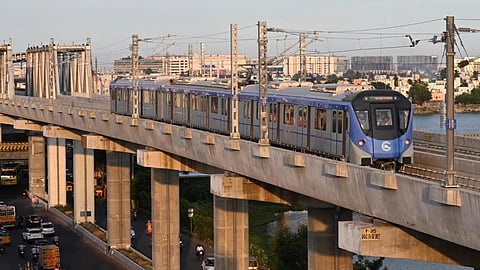
CHENNAI: The Poonamallee Bypass–Vadapalani stretch of Chennai Metro Phase 2 was inaugurated by Prime Minister Narendra Modi on Sunday, October 11, 2026, and is expected to improve connectivity across the city’s western suburbs.
Inaugurated by Prime Minister Narendra Modi on Sunday, October 11, 2026, the elevated corridor has been developed at a cost of around Rs 4,900 crore.
Spanning approximately 15 km, the stretch features 11 stations and forms part of Corridor 4 of Chennai Metro Phase 2, also known as the Yellow Line.
The new service is expected to make daily travel more convenient for office-goers, students and other commuters travelling between Poonamallee, Porur and Vadapalani.
According to reports, here are 10 key features of the new metro corridor, along with its station list, operating hours and train frequency.
The newly opened elevated corridor extends for approximately 15 km between Poonamallee Bypass and Vadapalani. It includes 11 stations, connecting residential neighbourhoods and major junctions across western Chennai.
The journey is expected to improve access to the existing metro network and reduce dependence on road transport for commuters travelling along this stretch.
The Poonamallee Bypass–Vadapalani stretch has the following stations:
Poonamallee Bypass
Poonamallee Bus Stand
Poonamallee Government Hospital
Karayanchavadi
Kumananchavadi
Kattupakkam
Iyappanthangal
Thelliyaragaram
Porur Bypass
Porur Junction
Vadapalani
Metro trains operate in both directions between the two terminal stations. The corridor is expected to provide better access to key residential and commercial areas along the route.
Passenger services on the new stretch commenced at 4 pm on Sunday, October 11, and continued until 9 pm on the inauguration day.
From Monday, October 12, regular services are scheduled to operate between 7 am and 9 pm in both directions. The last train departs from Poonamallee Bypass and Vadapalani stations at 9 pm.
These operating hours give commuters a new public transport option for travelling between western Chennai and the city’s established metro network.
The frequency of services varies according to the time of day and the day of the week.
Monday to Saturday:
Peak hours, from 8 am to 11 am and 5 pm to 8 pm: trains every 10 minutes.
Non-peak hours, from 7 am to 8 am, 11 am to 5 pm and 8 pm to 9 pm: trains every 15 minutes.
Sundays and public holidays:
Trains operate every 15 minutes between 7 am and 9 pm.
There is no separate peak-hour frequency on these days.
The schedule is designed to provide more frequent services during weekday commuting periods.
Vadapalani serves as the interchange point between the new stretch and Chennai Metro’s operational network. Passengers can connect to the existing Corridor 2 services at Vadapalani and continue towards destinations including Egmore, Chennai Central, Alandur and Chennai Airport, using the relevant connecting services.
This integration is expected to make journeys across different parts of Chennai more convenient by reducing the need to rely entirely on road transport.
The new corridor is designed to support train operations at speeds of up to 80 kmph. Faster operations, together with scheduled services and improved connectivity, could help commuters save time on regular journeys.
A total of 36 trains have been allocated for Corridor 4, while 10 trains are planned for initial operations, according to reports.
The corridor incorporates advanced metro technologies designed to improve safety and operational efficiency. These include:
Automatic Train Control (ATC)
Automatic Train Protection (ATP)
Communication-Based Train Control (CBTC)
Driverless train operation capability
Platform screen doors
These systems support train movement management, operational safety and more efficient service delivery.
Platform screen doors have been installed at stations along the corridor. The barriers help separate passengers from the tracks, reducing the risk of accidental falls and improving safety while people wait for trains.
The doors also form part of the broader safety infrastructure supporting the new metro service.
One of the notable engineering features of the project is a double-decker section measuring approximately 3.7 km. The structure accommodates transport infrastructure on two levels, helping optimise the use of available space.
The project also includes an interchange facility between Corridors 4 and 5. This is expected to support connectivity across the wider Phase 2 network as additional sections become operational.
The new metro stretch is expected to benefit commuters travelling between Poonamallee, Kattupakkam, Iyappanthangal, Porur and Vadapalani. Improved connections could help office-goers, students and residents access important destinations with greater convenience.
The corridor is also expected to support travel to employment centres and industrial areas in the wider western Chennai region, including locations connected to the Chennai–Sriperumbudur belt.
With its 11 stations, regular operating schedule and links to the existing metro network, the new stretch marks an important development in Chennai’s public transport expansion.