
- Chennai
- Tamil Nadu
- India
- World
- EntertainmentEntertainment
- Business
- Sports
- Lifestyle
- Technology
- Videos
- Explainers
- Editor's Picks

CHENNAI: Muthuswami Dikshitar’s music is known for its rich ragas, melodies and structure.
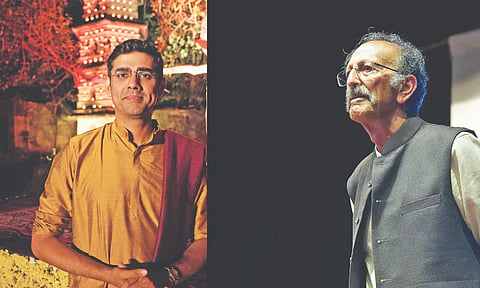
But his kritis also carry stories of temples, mythology, language and philosophy. Singing the Wind: Four Essays on Muttuswami Dikshitar brings together scholar David Shulman and vocalist Sikkil Gurucharan to explore these different aspects of his music.
For those unfamiliar with Carnatic music, the event will offer a chance to understand Dikshitar’s compositions through both discussion and performance.
David will talk about the literary, cultural and spiritual aspects of the selected kritis, while Sikkil will perform them.
“We naturally and correctly privilege Dikshitar’s music its remarkable musical structures, phrases, modes of emphasis, melodies, lyricism and so on,” David says.
But the kritis also have a strong verbal element, he adds. “Mostly in Sanskrit, a somewhat idiosyncratic Sanskrit with complex syntax,” the lyrics are an important part of the compositions. “When we listen well, we can feel the strength and clarity of the verbal text resonating in the singing.”
For David, one of the world’s leading scholars of South Indian culture, knowing the background of a composition can add to the experience.
This could be knowing which deity is being addressed, the temple associated with it or how a kriti fits into the Sri Vidya tradition. But he says this knowledge is not necessary to enjoy the music. “The music speaks for itself, no less so today than a hundred years ago,” he says.
The four essays focus on the Abhayamba kritis, Sri Kalahastisa, Akshayalingavibho and Srirajagopala. David says the selection is personal, especially since Dikshitar composed more than 400 kritis.
The chapter on Akshayalingavibho came after he and his wife heard Sikkil perform it in full at Raga Sudha Hall in Mylapore.
“It awakened a kind of ecstasy in both of us,” David recalls. Sri Kalahastisa, meanwhile, “appeared in my dream one night and asked me to write something about it”, while the Abhayamba kritis “simply reached deep into my heart or mind.”
David has loved Dikshitar’s music since he lived in Mandavelipakkam in 1975-76. He says repeated listening and reading the texts have helped him develop “a profound connection” with the music.
He also remains hopeful about the future of Carnatic music, pointing to young musicians who are developing their own styles.
For Sikkil, the music comes first. “It is the musical architecture first, the raga and the world of ideas behind it, and the lyrics,” he says. Learning a Dikshitar composition, he adds, means understanding its raga and musical structure, while the lyrics offer an insight into Sanskrit and the emotions of the period.
Sikkil does not feel that one needs to know the cultural background of a composition to perform it. “It was the music that attracted me towards a composition,” he says. However, scholars such as David can make musicians curious to learn more.
“They pique our interest towards learning something more about that kriti,” he says. This process, he adds, has “made me intellectually a better person”.
The format of Singing the Wind also gives Sikkil more freedom than a regular concert. He describes it as “a more free-flowing and adaptive manner”. Sikkil compares learning Dikshitar to peeling a jackfruit - difficult at first, but rewarding once one reaches the fruit inside.
“The more we age as a musician, not in terms of physical years, but in terms of repertoire that we learn, even of other composers, the more we perform Dikshitar’s songs, the more I’ve sung Akshaya Linga Vibho or Ehi Annapurna, I feel I’m getting closer to the original bhava in which Dikshitar intended the song to be performed.”
For Sikkil, another strength of Dikshitar’s compositions is their structure. He says Dikshitar varied the format of his compositions while maintaining a strong rhythmic framework.
“If you preserve that integrity in a very honest way, I think the composition is already accessible for everyone who is encountering his music for the first time,” adds the musician. He believes Dikshitar’s work is 'as contemporary as it is traditional'.
Singing the Wind: Four Essays on Muttuswami Dikshitar, jointly organised by The Music Academy, Madras and Prakriti Foundation, will be held on September 6 at 10.30 am at the Music Academy. Entry is free and open to all.