
- Chennai
- Tamil Nadu
- India
- World
- EntertainmentEntertainment
- Business
- Sports
- Lifestyle
- Technology
- Videos
- Explainers
- Editor's Picks

CHENNAI: Several Tasmac liquor outlets located near schools, colleges, places of worship and medical institutions continue to operate in Chennai despite the State government’s recent announcement that shops situated within a 500-metre radius of such locations would be shut down.
The closure of 717 Tasmac outlets that fall within this diktat was among the first major decisions announced by Chief Minister C Joseph Vijay after the TVK government assumed office. And, shortly thereafter, these shops were closed by June 5.
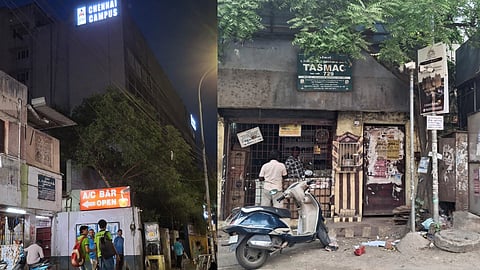
However, complaints from residents suggested that a number of outlets falling within the prescribed distance continue to function. A field inspection by DT Next found several Tasmac shops are still operating close to schools, religious institutions and public gathering points across the city.
One such outlet is Shop No 931, located adjacent to the Chennai campus of the Indian Institute of Management (IIM) Tiruchirappalli. The outlet is also situated near the Kasi Theatre bus stop, a major transit point used by thousands of commuters every day.
Residents alleged that customers frequently consume alcohol in and around the area and engage in activities that cause inconvenience to the public. Urination near the premises has become a recurring issue, creating foul odour and affecting people who use the bus stop and surrounding public spaces.
Another one – Shop No 729 on Gangai Amman Koil Street in Jafferkhanpet, is located around 300 metres from a Corporation school. Similarly, an Elite Tasmac outlet inside the Kasi Talkies Commercial Complex is reportedly located around 100 metres from Chaitanya School.
Senthamizh Selvan, whose child studies at the school, said the continued operation of the outlet raises concerns about enforcement of the government’s directive. “If regulations prohibit liquor outlets near educational institutions, authorities should clarify why this shop continues to function. A bar operating within the same complex also remains open,” he averred.
Representatives of Tasmac employees’ unions have also raised questions regarding the implementation of the closure order. A Thiruchelvan, general secretary, TASMAC Employees (CITU) Union, said, “The closure list of 717 shops was prepared without detailed field verification. Existing Tasmac and bar regulations framed in 2003 already contain distance restrictions from educational institutions, with separate norms applicable to Corporation, municipal and rural areas. Those regulations have not been amended so far. A strict implementation of the 500-metre norm across TN will affect a much larger number of outlets than those identified in the list.”
According to him, nearly 2,500 Tasmac shops across the State could fall within the proposed distance criteria if the rule was applied uniformly. He also questioned why outlets operating near major transport hubs, including Egmore railway station and several suburban stations, continued to function despite serving areas with high public footfall.
“Many village assemblies have repeatedly sought the relocation or closure of liquor outlets in their localities. Those demands also require attention if the government intends to regulate the location of Tasmac shops comprehensively,” he opined.
Residents have also raised concerns about Shop No 623 on Kodambakkam High Road and Shop No 518 in Rangarajapuram, alleging that both outlets were located near hospitals, educational institutions, bus stops and places of worship. Deepika, a resident of T Nagar, said, “Tipplers often gather near public spaces around the Kodambakkam High Road outlet. They consume liquor near the Corporation Park, bus stop and other public areas. Empty liquor bottles are frequently left behind. During afternoon and night hours, drunkards are seen sleeping on pavements used by students and residents. Patients visiting Saravana Heart Hospital, devotees travelling to Erikarai Mariamman Temple, women, senior citizens and schoolchildren face inconvenience due to such activities.”
Nagavalli, a resident of Rangarajapuram Main Road, said liquor consumption near public facilities and religious institutions has become a concern for local residents. “Vehicles parked around the shop often obstruct traffic movement and contribute to congestion. People travelling to offices, schools and temples are forced to navigate an uncomfortable environment. Authorities should take immediate steps either to relocate these outlets or address the problems associated with them,” she rued.
With complaints pouring in from multiple neighbourhoods, residents and stakeholders have called on the State government to review the implementation of its closure order and ensure compliance with the announced distance norms