
- Chennai
- Tamil Nadu
- India
- World
- EntertainmentEntertainment
- Business
- Sports
- Lifestyle
- Technology
- Videos
- Explainers
- Editor's Picks
We often admire a dish with our eyes before tasting it when it appears on our feed. A drizzle of chocolate sauce or the satisfying pull of melted cheese, these moments are meticulously captured to make viewers pause and immerse themselves in the drool-worthy scroll.
In a city like Chennai, where restaurants, cafés, home bakers, food brands, and cloud kitchens are steadily expanding the culinary landscape, striking visuals have become an essential ingredient.
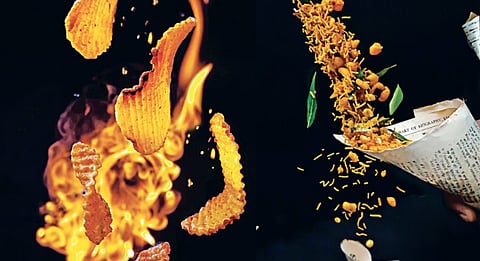
What was once limited to straightforward menu photography has now evolved into a creative craft that combines styling, storytelling, and digital strategy.
With many emerging visual storytellers stepping into photography, this fresh creative upgrade in the food genre is quite invigorating and has also raised the standard for advertising photography.

The self-taught creative journeys
A junior national champion in tennis, Neeraj Elangovan’s goal was to be the best in the sport. However, Covid 19 and a few injuries in 2020 pushed him into the dilemma of choosing his next step.
“Though I didn’t have prior knowledge of videography, I started experimenting with creative food storytelling on my own during the lockdown. When my friends from different advertising agencies appreciated my videos, I started posting them on Instagram,” says Neeraj Elangovan.
Many of us might have come across a reel where an elderly woman plays around with ingredients, accompanied by distinct visuals. “My grandmother was the pillar who encouraged me to try this,” he adds.
The top-down angle is the most commonly used shot in cooking videos. “I was clear that my work should be unique. My videos should reflect my emotions for food. So, I do not use tripods or gimbals, and instead go with hand-held shots to play around with angles, close-ups and wide shots,” he states.
Another videographer, Valarmathi, was born and raised in Panagudi in Tirunelveli. The self-taught photographer was drawn to the details in macro photography and wanted to delve deeper into it in 2013.
After completing her Master’s degree, Valarmathi shifted her focus to learning the art professionally. “In our town, people only knew wedding photography. So when I approached a few popular studios in Tirunelveli to join as an assistant, they simply rejected me, saying that women cannot handle the groundwork. They recommended that I learn editing and do a desk job,” she says.
But that didn’t stop her, and she started a YouTube channel. The few views did not discourage Valarmathi. “I was doing everything by myself, and my sisters were my backbone. After a while, Instagram reels started trending. One of my initial creative food videos garnered huge traction, and that’s when I ventured into this genre,” notes the 29-year-old. With her trending videos, brands started approaching her.
Gradual recognition for creative shots
Even though creative food photography has existed for some time now, it has yet to steal the spotlight like other photography genres, including wedding, portrait, nature and wildlife photography, among others, in the South.
“We are improving, but not at the speed that people are progressing internationally. In the south, people lean more towards emotional storytelling, which is traditional and close to home. However, in the north, we see a lot more experimental work. I think here the risk-taking factor is limited, and people are playing it safe,” shares Neeraj, adding that food styling is another emerging field that needs more limelight.
“Ideas are the key. As we are all connected with food, ideas flow naturally. I enjoy the way my brain becomes creative when it comes to this form of storytelling. Compared to the past five years, there is a drastic change in the way food is shot. Networking with brands has also become quite easy as we already have an established portfolio on social media,” Valarmathi explains.
Talking about how difficult it is to reinterpret familiar dishes like filter coffee, dosa, and idlis, Neeraj says it can be quite challenging. “There is an increasing demand for digital assets and these kinds of food videos. From a commercial perspective, however, the budget is restricted in Chennai. We are yet to unleash our full potential, and the market is emerging,” he adds.
Building portfolios, generating revenues
Instagram and YouTube have further transformed the landscape. Analytics, emerging visual trends, and even AI tools are increasingly shaping how food content is conceptualised, produced, and consumed. These platforms play a vital role in helping visual creators build their own brands and secure client opportunities.
“With all the skills and videos, using social media to build our own brand is the most essential part. We can connect with like-minded audiences as well as clients. Instead of waiting for the best work to be posted, share everything from the beginning. People like to see the evolution of work over time,” Neeraj suggests. He highly recommends building a strong work base and narrowing down to one particular category to experiment further. “Don’t look at the commercial aspect in the beginning. Each brand is a learning experience. Work with as many as possible and build a team to increase your revenue,” the 31-year-old shares, stressing that viewing analytics carefully is key, as it helps improve work further.
Before social media, the norm was to assist a senior photographer and build a portfolio under their brand. “But now, skills, hard work and consistency are all that are needed to move forward and actively earn. Social media has definitely made things easier, but staying relevant and creative will make us stand out,” Valarmathi affirms. Platforms like Instagram have opened new avenues for revenue generation, from brand collaborations and restaurant campaigns to sponsored content and digital promotions. There remains immense scope for experimentation with concepts, motion graphics, and AI-assisted tools that can push food imagery beyond conventional frames and further redefine how Chennai’s culinary stories are told online.
Artificial Intelligence plays a significant role in creative fields, and photography is no exception. But how it is used is what truly matters. “Keeping the visuals authentic is crucial. Manipulating them with AI will not reflect the storyteller's creativity. I use AI tools during the pre-production stage, specifically for scripting. It greatly reduces production costs as everything is clearly planned,” Valarmathi explains.
For Neeraj, AI is a powerful tool for storytelling, and its impact is significant. “But directly using AI on food largely compromises the quality. The food visual will lose that strong emotional connection and appear vague. AI’s use will penetrate more in setting the narrative and improving workflow, thereby reducing production time,” he adds.