
- Chennai
- Tamil Nadu
- India
- World
- EntertainmentEntertainment
- Business
- Sports
- Lifestyle
- Technology
- Videos
- Explainers
- Editor's Picks

CHENNAI: An English willow has been cut, shaped and is waiting to be soaked and pressed at a small workshop in Kodambakkam, where a 27-year-old Surya Narayanan has been manufacturing bats for the past three-and-a-half years.
Having been around the sport since his childhood, playing it professionally until COVID-induced lockdown, Narayanan turned his attention towards repairing bats – making it his career.
“I played cricket for over 8 years until COVID put a break to everything,” he recalls. “I spent most of my time on the ground and not in classes. I did not have much of any skill other than in cricket. So I decided to do what I knew best, that is, repairing bats,” he says.
That’s how his venture, ‘Bat’s Man (BM)’ was born. Within a few months of starting his business, he took up selling bats in 2021, which meant he was no longer stationary in Chennai. The business required him to take multiple trips to Meerut – the hub of cricket-bat manufacturing in the world.
“I took a 40-day course to learn Hindi, and stayed in factories there for 10-15 days to learn the craft,” he says. “My foundation in repairing bats helped me learn the craft of making them easier. I realised that to stand apart in a city like ours, I need to start manufacturing.”
Now his business has boomed to a scale where he sells bats to many seasoned cricketers, including Shahrukh Khan, Washington Sundar and others who have represented the country. “‘Salem Spartans’ M Mohammad, Trichy Grand Cholas’ Vijay Abhimanyu, Vida Kovai Kings Shahrukh Khan are some of the people we sponsor bats to,” he says.
In one year, BM aims to produce around 1,500 willows, sold both in the country and worldwide.
Cricket bats are customised to each player, which Narayanan specialises in.“Sometimes a new bat would not suit them, it needs to be tweaked, like a glove. So they come here for customisation. A bat needs time to settle with the player, and once it does, it’s pretty difficult to change to a new bat,” he explains.
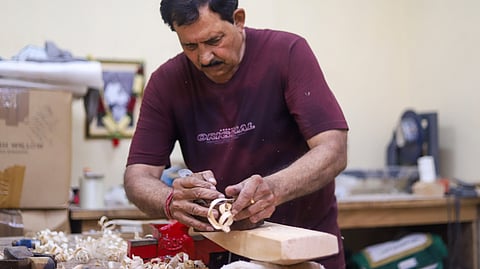
In the background are two of Narayanan’s key employees, Rajkumar Bhagat (68) and Sunny. Bhagat has been making bats since 1976, much before India put itself on the world map with the 1983 World Cup win.
“I was involved in making bats for the 1983 World Cup squad,” he says in his Punjabi-mixed Hindi, as he shows a picture of him and Kapil Dev examining a bat. “I made bats for Roger Binny, Madan Lal, Kapil Dev – all of them. I was a cricketer too, but couldn’t continue playing, so I got into bat making.”
Bhagat demonstrated the now-soaked bats, which he presses, so that the extra moisture content is removed from the bat. Then he picks up a hammer and hits the bat, showing how strong it has become. “It hardly takes two hours to make a bat but it needs time to rest and cool down and soak, so we do it in two days. The handles are exported from Singapore, as it’s made of Singapore cane,” says Rajkumar, with only 20 bats made in each batch to control quality.
While making Kashmir-willow bats is easier and also cheaper, nobody buys it here. “The willow comes from the UK. When I mailed the willow vendors there, they said there’s a waiting list of four years. Some of the cricketers I know and well-wishers helped me.”
The price of willow has increased thrice this year alone but a bat at BM costs around Rs 12,000 – one of the cheapest in the city. That is also a reason why there’s so much demand for the bat repairing business.
“A bat can be rendered useless only when it breaks into two from the middle. Everything else is fixable,” he explains. “This is a one-time buy due to the cost,” he adds.