
- Chennai
- Tamil Nadu
- India
- World
- EntertainmentEntertainment
- Business
- Sports
- Lifestyle
- Technology
- Videos
- Explainers
- Editor's Picks

CHENNAI: The message the three sisters left behind was not long. “Korea is our life. Korea is everything to us.” Within hours, Nishika (16), Prachi (14), and Pakhi (12) were dead, having jumped from their ninth-floor apartment in Ghaziabad earlier this year. Police said the girls had become intensely immersed in Korean digital content and a task-based online game.
The process is a quiet trap: it begins with harmless daily tasks that slowly become a rigid routine. Much like the 'Blue Whale' challenge, these online 'missions' are designed to create a deep psychological bond. Over time, the game stops being a hobby and starts feeling like a command, leaving vulnerable teens feeling as if an unseen handler is directing their every move.
The case jolted the country, not because teenagers follow global culture, but because it revealed how algorithm-driven ecosystems can overwhelm adolescent vulnerability.
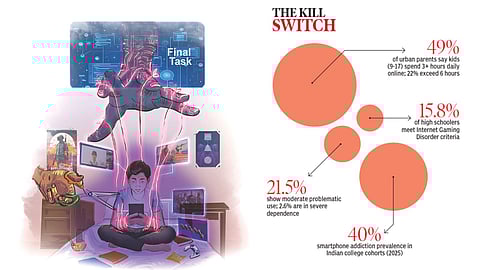
India’s youth are spending unprecedented hours online. A 2025 LocalCircles survey found that 49% of urban parents reported that their children aged 9-17 spend more than three hours daily on social media and streaming platforms, while 22% reported usage exceeding six hours.
Clinical research signals a bigger risk. A 2025 cross-sectional study in Ahmedabad found 15.8% of high school students met criteria for Internet Gaming Disorder (IGD). A meta-analysis in the Indian Journal of Community Medicine reported that 21.5% of Indian adolescents show moderate problematic internet use, with 2.6% in severe dependence.
In 2019, the WHO classified Gaming Disorder under ICD-11, but Indian psychiatrists say the same behavioural architecture now applies to binge-streaming and hyper-fandom. This engagement affects a brain still in development. In adolescents, the limbic system — governing reward-seeking — matures earlier than the prefrontal cortex, which regulates impulse control.
“Algorithm-driven platforms repeatedly stimulate dopamine pathways through rapid, variable rewards, increasing reward sensitivity while weakening the ability to delay gratification. Over time, this can impair attention span, motivation, and self-regulation,” said Dr Kurinji GR, Consultant – Psychiatry, Kauvery Hospital.
“Healthy fandom is adaptive; young people are able to balance their interests with sleep, academics and relationships. It becomes pathological when engagement turns compulsive, when individuals cannot control their consumption, become irritable when access is restricted, and continue despite academic or social consequences. The defining marker is not the number of hours spent, but the loss of control and the presence of harm,” she told DT Next.
This is not an accidental design. Streaming and gaming platforms optimise for ‘time-on-platform,’ a metric tied directly to advertising revenue and subscription retention. Infinite scroll, autoplay sequences, and notification triggers are engineered to reduce friction and extend engagement.
Dr Vasanth, a senior consultant psychiatrist in Chennai, sees the clinical consequences: “A teenage girl from a middle-class family insisted her parents take her abroad for a K-pop concert and said she would study only if they agreed. When desire overrides reality testing, we assess it as behavioural addiction.”
The Korean wave, or Hallyu, accelerated during COVID-19 lockdowns. Lara (20) said she began watching Korean dramas then. “Now I understand parts of the language. Some words feel similar to Tamil,” she said. For others, cultural immersion reshapes aspirations.
Vanuja, a Chennai native who moved to South Korea, says, “Many boys admire Korean facial features, even comparing them to people from the Northeast. Many girls want a partner like Korean actors. It gradually influences how we see relationships.”
Even Koreans notice the intensity. Ha Sujin, who studied in Chennai, said, “In Korea, we follow celebrities and watch dramas. But sometimes the enthusiasm in India feels stronger.”
The vulnerability is magnified by broader trends. The National Crime Records Bureau (NCRB) recorded 1,71,418 suicides in 2023, with adolescents forming a significant proportion. While suicide is multifactorial, clinicians say excessive screen exposure often intersects with academic pressure and social isolation.
Globally, governments have acted: South Korea has experimented with gaming curfews, and China has imposed strict time limits for minors. The European Union is tightening digital services regulations, requiring greater transparency from platforms about algorithmic design.
India, however, lacks a comprehensive national framework addressing adolescent screen exposure. The Economic Survey 2026 flagged digital addiction as a risk to youth productivity and mental health.
India's Chief Economic Advisor recently suggested exploring age-based limits on social media access. But beyond advisory statements, enforceable safeguards remain limited. Public health experts stress this is not a cultural debate but a systemic one. Korean cinema and music have global artistic merit. The concern is systemic: commercial digital architectures intersecting with developing brains.
“The issue is not fandom. It is a compulsion reinforced by design. Parents must look for warning signs: irritability when devices are removed, academic decline, sleep disruption and withdrawal from real-world relationships. Dialogue and structured limits are critical,” Dr Vasanth noted.
But when a digital world becomes "everything" to three young sisters, the cost of that compulsion becomes impossible to ignore.
49%
of urban parents say kids (9-17) spend 3+ hours daily online; 22% exceed 6 hours
15.8%
of high schoolers meet Internet Gaming Disorder criteria
21.5%
show moderate problematic use; 2.6% are in severe dependence
40%
smartphone addiction prevalence in Indian college cohorts (2025)
‘SITTING DUCKS’
FOR ADDICTION
~ In teens, the limbic system (pleasure-seeking) is fully developed, but the prefrontal cortex (impulse control) isn't. This makes them biological "sitting ducks" for addiction
~ Games use "missions" and infinite scrolling to trigger small chemical hits in the brain, making it physically difficult for a child to stop
~ The shift from "harmless" tasks to dangerous behaviour is often steered by unseen handlers who foster emotional dependence
PARENTAL
RED FLAGS
~ Extreme irritability or aggression when the device is taken away
~ Skipping meals, sleep disruption, or sudden academic decline
~ Quitting real-world hobbies for "digital-only" social groups
~ Refusing to study unless "rewarded" with more screen time