
- Chennai
- Tamil Nadu
- India
- World
- EntertainmentEntertainment
- Business
- Sports
- Lifestyle
- Technology
- Videos
- Explainers
Chennai
THE British royalty ruled half the world by the middle of the 19th century and nowhere else did they face such a vehement opposition as in India. Many freedom fighters took to the sword valiantly and paid for it with a trip to the gallows. Others stood in the dock and told the British judge that he had no right to try them as the British had no right over this land in the first place. The third category of the freedom fighters was different, who though reiterating that the Indians possessed the right to rule, themselves argued that in breaking laws while demanding freedom from the fetters, Indian nationalism was setting the wrong precedent for future citizens when it became free. Today, when we open the newspapers and read of a thorough misuse of Gandhian methods, we can see how right they were.
Unsurprisingly, the liberals were always at loggerheads with the satyagraha-style movement of disobedience to the British, based on their faith in the rule of law. Those who tried to fight for Independence through constitutional methods had at that time turned irrelevant before the Gandhian colossus and were completely forgotten later while writing the history of the freedom movement.
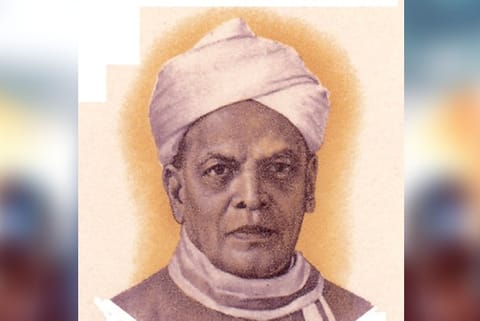
The liberal movement had been formed by Gopala Krishna Gokhale who kept his seat warm for his chosen successor Gandhi. However, the voice of the liberal party, as it was called and its leadership was the Madras-based ‘silver-tongued’ Srinivasa Sastri as Gandhi moved into direct action.
The liberals had to face accusations of being British backers and during one of his speeches on ‘The Political Situation in India’ in Washington, Sastri was attacked by a mob, accusing him of being a British proxy, and had to be hurriedly escorted out by the police.
Valangaiman Sankaranarayana Srinivasa Sastri was born ten days ahead of the Mahatma — a fact Gandhi never let him forget, always calling him ‘Anna’, the Tamil word for elder brother. Born in a poor family near Kumbakonam, Sastri rose to what his social limits allowed him to — a school teacher. He was trained at the Saidapet Teacher Training College, where he reportedly corrected the pronunciation of the English principal himself and a Standard English Dictionary from the library adjudicated that Sastri was right and the principal congratulated him for his meticulousness.
Sastri considered the teaching profession as the noblest. For half a century, he served from a humble school teacher to the highest position of vice-chancellor in his career. A South African school he started in Durban still exists as ‘Sastri college’.
After 17 years of teaching at various schools including the Hindu School of Triplicane (the only Madras school to count a Nobel laureate as an alumnus), Sastri resigned and threw himself headlong into politics. Surprisingly, this was after reading just one pamphlet written by Gokhale as part of Servants of India Society. He served the society admirably and on Gokhale’s death became the president, a position Gokhale had earlier groomed Gandhi for till their footpaths to freedom differed.
Though they were at loggerheads over the Civil Disobedience movement, Gandhi’s relationship with Sastri, rather than icy was quite warm. The first of the three Round Table Conferences of 1930–32 was highly ineffectual with Gandhi boycotting it. Sastri played a big role in bringing Gandhi to the table for the second conference. Sastri himself represented the liberals for the second and third conference. Gandhi’s autobiography was edited by Sastri.
Sastri did not consider taking up assignments under the British as erroneous and did his stint as a roving diplomat of colonial India in South Africa and League of Nations and as its ambassador to plead the cause of Indians in Canada, Australia and other countries in the Empire.
While addressing a meeting in the South African town of Klerksdorp, the lights went off and a gas bomb was thrown at the stage. The police cleared the auditorium and an unshaken Sastri continued his talk on the lawns of the hall. “...as I was saying before the venue of the meeting was altered from indoor to the open air,” he started setting the audience roaring with laughter and in approval of his pluck.
The British too seemed to like this approach and Sastri was made a member of the Privy Council and The Freedom of the City of London was conferred on him. Though a global citizen, Sastri Srinivasa Sastri, concerned with the neighbourhood he lived in, established India’s first cooperative society, the Triplicane Urban Cooperative Society (TUCS), in 1904, which still runs after a century.
VS Srinivasa Sastri was a perceptive reader and writer. He gave long extempore lectures across the Empire and was known for his mastery in English oratorial skills. He was often introduced as ‘the silver-tongued orator’ before his turn to speak. India today is the largest English speaking country in the world and people like Sastri are hugely responsible both for respecting that English would become the lingua franca of the world and using their belief in their career of teaching and school administration. And also setting an example to the countrymen that learning English moved one up in history.
By the forties, Gandhian movement had all but secured the freedom, and Sastri was sadly forgotten by most except the man one could consider responsible for it. In 1946, and on his last visit to Madras, Gandhi would visit a dying Sastri thrice — twice in the hospital and once in his Mylapore residence, a record for the time-strapped Mahatma.
A Sastri College in Durban built out of funds raised by him, and an auditorium in Chidambaram and a lecture hall on Luz are possibly the only buildings remaining in his remembrance.
— The author is a historian
Visit news.dtnext.in to explore our interactive epaper!
Download the DT Next app for more exciting features!
Click here for iOS
Click here for Android
