
Chennai
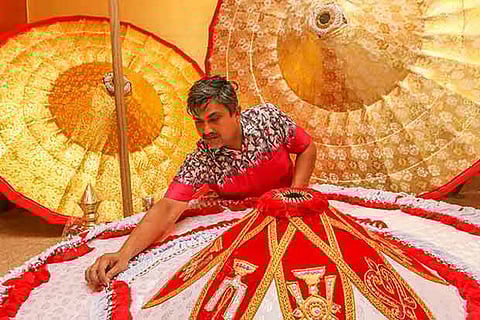
PS Gajendra Sha is the third generation of artisans, who have been involved in handcrafting of the umbrellas, cloth embroidery and similar awnings that decorate gods in temples. He and his extended family of cousins have been engaged in the age-old vocation, operating out of their shops on Iyah Mudali Street.
After seeing off the customer, Gajendra details the longdrawn process. He says, “After washing and drying bamboo sticks, frames are woven for the umbrellas to be covered with cotton or velvet cloth. Every decorative element on it is handmade, from the elephants to the gold or silver strips that run through it—the outlines are traced and cut manually. The sizes of these umbrellas can go up to six feet,” he says.
The umbrellas are part of the offerings by devotees, who sometimes keep the family tradition of making the offers on special occasions. The bigger ones are made for temple festivals. Gajendra says, “I make these umbrellas for the Parthasarathy Swamy Temple in Triplicane and also for Kapaleeswarar Temple and the Amman Temple in Thiruverkadu. In fact, I take up orders even for Garuda Sevai in Venkateswara Temple in Tirupati.” Gajendra says during a good month, he earns up to Rs 80,000.
Shas are Saurashtrians, who were traditionally known as the ‘pattunoolkaras’, owing to their silk-weaving business, which has been passed down generations. Born and raised in an environment steeped in the craft, the entire family is involved in the making of the temple decorations.
A few shops away, Gajendra’s first cousin Shyam Sundar (44), who exclusively makes the umbrellas, especially for the Kandasamy Kovil, operates out of his small unit. His business is in full swing between February and October, before the annual lull in the later months.
“I have just begun for this season. I can’t predict the sales — each season has its positives and negatives. I am hoping this one is very good.”
Their older cousin C K Kumar (48) has taken his decorations to Singapore, Sri Lanka, Myanmar and Malaysia. “The Murugan Temple in Singapore places their order with me,” he says, beaming with pride.
“The decoration for Kamadhenu in Myanmar temples too are from here,” he says. Kumar has just finished his order from a temple in Anantapur, Andhra. Gajendra says that
there is no competition among them. “We have been doing it briskly without being at loggerheads, despite being in the same trade,” he says.
While the Shas are keen on keeping the tradition alive, a possibility of it ending with this generation is looming large as the craft has remained in the family. According to them the courtesy goes to more lucrative professions in the offing for the next generation. Kumar says, “My son is pursuing a course in Industrial Training Institute. He knows the craft, but I am not sure if he will take it up like me, though I am determined to pull him into it.”
Shyam Sundar echoes his sentiments, with respect to his two sons. “I don’t know if they would be keen on keeping it alive, as we have been doing it so far.”
Visit news.dtnext.in to explore our interactive epaper!
Download the DT Next app for more exciting features!
Click here for iOS
Click here for Android