
- Chennai
- Tamil Nadu
- India
- World
- EntertainmentEntertainment
- Business
- Sports
- Lifestyle
- Technology
- Videos
- Explainers
- Editor's Picks

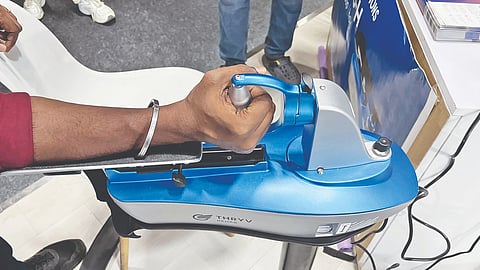
CHENNAI: A rehabilitation robot developed by IIT Madras and Christian Medical College (CMC), Vellore, seeks to make repetitive physiotherapy more engaging, using interactive games and robotic assistance to help patients work towards regaining hand function.
Called PLUTO-H, the device is being commercialised by Thryv Rehab Solutions, which showcased it at an Electronics Corporation of Tamil Nadu (ELCOT) stall at the India Game Developer Conference 2026 at the Chennai Trade Centre here on Wednesday.
The technology addresses a persistent challenge in stroke rehabilitation: patients often need to repeat the same movements over extended periods, while frequent therapy sessions can be difficult to sustain because of time, travel and clinical resource constraints. PLUTO-H combines robotic mechanisms with game-based exercises to train hand, wrist and forearm movements. Its interactive software provides visual feedback and allows exercises to be adjusted to a patient’s ability.
The aim is to encourage active participation while enabling therapists to monitor performance and tailor rehabilitation. The platform builds on PLUTO (Plug and Train Robot), developed by IIT Madras’ TTK Centre for Rehabilitation Research and Device Development and CMC Vellore. Its modular design uses a motor with interchangeable attachments to train different movements, including wrist bending, forearm rotation, hand opening and closing, and functional gripping. The original PLUTO system has undergone clinical use and evaluation in India.
IIT Madras reported in January 2025 that the technology had been used by more than 1,000 patients and tested in Indian homes, including a preliminary four-week study involving stroke survivors. The findings offered encouraging evidence of feasibility, although larger studies are needed to establish effectiveness across patient groups.
“The idea is to make repetitive rehabilitation exercises engaging through gamification. Patients may lose interest when they have to perform the same movements repeatedly, but games can make the sessions more interactive,” said Durgesh Kumar, a game developer associated with the product, speaking to DT Next. “The unit’s manufacturing cost is around Rs 9.25 lakh. Further refinement and pilot testing are under way. Wider commercial adoption will take time.”