
- Chennai
- Tamil Nadu
- India
- World
- EntertainmentEntertainment
- Business
- Sports
- Lifestyle
- Technology
- Videos
- Explainers
- Editor's Picks

CHENNAI: With the Tamil Nadu government pushing ahead with the construction of the Mamallan Reservoir, a major drinking water project intended to strengthen Chennai’s water security, bird watchers and environmentalists are raising concerns that the project could irreversibly damage one of the region’s most important coastal wetland ecosystems.
The Mamallan Reservoir project, located at Nemmeli in Chengalpattu, was conceived as Chennai’s sixth major drinking water reservoir. Launched during the previous AIADMK government at an estimated cost of Rs 342.60 crore, the reservoir is designed to store 2.25 TMC of water and supply 170 MLD to nearly 13 lakh residents across the rapidly expanding southern suburbs, including Sholinganallur, Siruseri, Kelambakkam, Tiruporur and Mamallapuram.
Spread across more than 5,161 acres and drawing water from a catchment area of over 41,000 hectares, the project has been projected as a long-term solution to Chennai’s growing water needs. Authorities have also argued that the reservoir would improve groundwater recharge, prevent seawater intrusion and strengthen water security for future generations.
However, the site chosen for the reservoir is also a biologically rich coastal wetland where freshwater and seawater naturally mix, creating a productive brackish water ecosystem that supports fish, crustaceans, migratory birds and numerous wetland species.
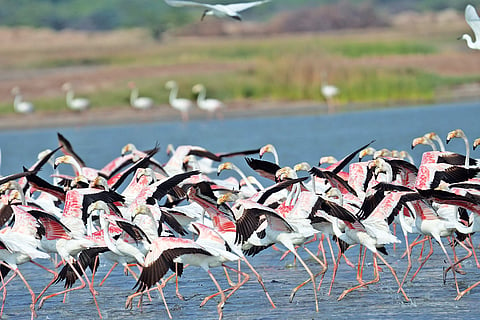
Naturalist Narendra Prasath V, who has been documenting birdlife in the area, said the great salt lake in Nemmeli has emerged as a crucial feeding, wintering and breeding ground for both resident and migratory birds. According to him, hundreds of Greater Flamingos were recorded feeding in Nemmeli earlier this year, with birders observing more flamingos at the site than even at Pulicat during certain periods.
“Flamingos depend on algae, and small crustaceans thrive in areas where freshwater and seawater mix in the right proportions. If the natural exchange of water is disrupted by the reservoir, these birds may lose an important feeding ground,” he said.
Nemmeli is also part of the Central Asian Flyway, one of the world’s major migratory bird routes. Several migratory species from Central Asia, Europe and Russia use the wetland as a winter refuge or stopover site during their long journeys.
Environmentalists argue that the significance of Nemmeli extends beyond migratory birds. During summer, when water becomes scarce elsewhere, many resident bird species breed in the wetland’s mudflats, grasslands and salt marshes.
Species such as the Great Thickknee, Indian Thick-knee, Oriental Pratincole, larks, pipits, swallows and several wetland birds rely on these habitats for nesting and raising their young.
According to conservationists, roads constructed through wetland areas and ongoing embankment works have already begun disturbing breeding grounds. Pointing out the removal of nutrient-rich topsoil for construction activities, they warned that it could lead to the loss of rare plant species and further degradation of the ecosystem.
Fishermen and residents from more than 16 coastal villages have staged protests, expressing fears that converting the brackish water backwaters into a freshwater reservoir would affect traditional fishing activities, shrimp resources and local livelihoods.
KVRK Thirunaranan, founder of The Nature Trust, said, “We have witnessed nearly 1.5 lakh resident and migratory birds using this landscape. Birds from several countries visit this great salt lake every year.
This could be the last season for many of them if the habitat is permanently altered.” He noted that species such as the Greater Flamingo would be among the worst affected by the transformation of the wetland.
Thirunaranan said the Little Stint, a tiny migratory shorebird, travels nearly 8,000 kilometres from the Russian region to reach Nemmeli. Similarly, the Eurasian Wigeon undertakes journeys of around 12,000 kilometres before arriving at the wetland.
“If these habitats disappear, birds that have depended on them for generations may lose a critical stopover and feeding site along their migratory route,” he warned.