
- Chennai
- Tamil Nadu
- India
- World
- EntertainmentEntertainment
- Business
- Sports
- Lifestyle
- Technology
- Videos
- Explainers
- Editor's Picks

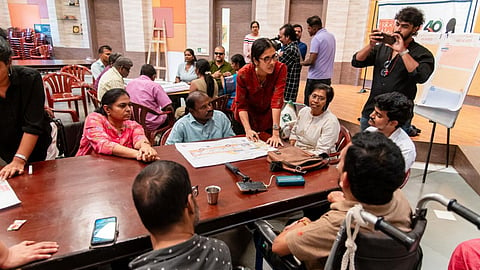
CHENNAI: To better understand the barriers faced by Persons with Disabilities (PwDs) in public spaces and transportation, the Citizen Consumer and Civic Action Group (CAG) held a focus group discussion here on Saturday.
CAG, which initiated such a discussion for the first time, aims to bring together diverse voices to share experiences, challenges, and ideas to improve mobility for PwDs in the city.
At least 40 PwDs, who participated in the event, shared their inputs and ordeals of navigating transit services and public spaces overall.
Kavipriya, researcher of sustainable mobility and road safety with CAG, said, “Under sustainable mobility, we planned to understand the challenges faced by PwDs in Chennai. Surprisingly, we were able to gather more inputs than anticipated.”
CAG will conduct more focus groups with PwDs among other stakeholders, including elderly persons, to comprehend barriers in public spaces like parks, malls and theatres and public transportation before releasing their observations and inputs to the government. “We’ll extend the study for a few more weeks before fully comprehending the gravity of challenges faced by PwDs,”she added.
For the pilot focus group, however, CAG saw participation from people with locomotive disability and visual and hearing impairment. And, transport systems were divided into MTC bus, Metro Rail, MRTS, ride-sharing apps like autos and cabs and public spaces in general.
As part of the discussion, the participants shared that among different public transportation systems, the Chennai Metro Rail has been the most inclusive, and the least inclusive was the MRTS. “Though there are lapses in the design of Metro Rail as well, for instance, a gap between platform and train, CMRL is the most inclusive so far. MTC has initiated a slew of low-floor buses aiding PwDs. But, MRTS still largely eludes inclusivity,”said a PwD during the discussion.
Some of the other inputs are: behavioural training for conductors and drivers of MTC, no additional chargers for wheelchairs inside the bus, frequent and thorough assessment of public transportation and autos and cabs to meet guidelines for inclusivity.