
- Chennai
- Election-2026Election-2026
- Tamil Nadu
- National
- World
- Cinema
- Business
- Sports
- Lifestyle
- Technology
- Videos
- Explainers
Chennai
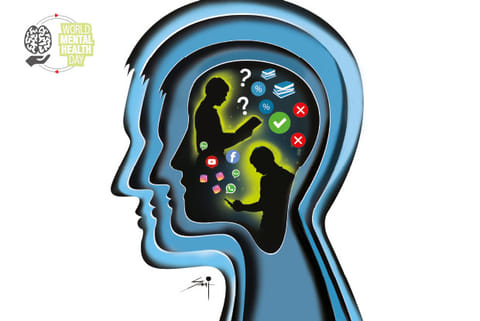
The theme for this year’s World Mental Health Day set by the World Health Organisation universally is one that requires desperate attention in today’s age: Young People and Mental Health in a Changing World.
A study by the WHO last year found one in four teenagers and adolescents in India to be suffering from mental health issues, including depression, anxiety, stress and other disorders. In an increasingly open and competitive climate, adolescents have to contend with pressures that confront them from different quarters such as family and peer groups. The proliferation of social media and the need to project a perfect life is also a leading cause for discontentment among the youth today.
Adolescents face the conventional pressures of scoring high marks, performing well in examinations and managing expectations from family while trying to find their place in the world both professionally and personally. Though there has been more awareness about pushing the youth to perform well academically at the cost of their me talk well being, there are still many instances where such earnings have been disregarded. The frequent reports of suicides of students who are looking to make the cut into top universities or unable to keep up with the rigour of studying in a demanding environment has not declined. Since 2013, 77 suicides have been reported in the city of Kota, Rajasthan which is famous for its coaching institutes.
In addition to this, adolescents are becoming increasingly vulnerable as a result of peer pressure and through social media in the digital age. This networking platforms that provide the youth a window into the world also makes constants demands of them to look and act a certain way to belong and fit it, taking a toll on their mental health. A snapshot survey conducted last year by the UK’s Royal Society for Public Health concluded that photo app Instagram to have the worst effect on the mental health of the respondents aged between 14-24. The study also identified tat social platforms left the youth largely vulnerable by causing depression, anxiety, loneliness, bullying and body image issues.
As more adolescents grapple with these issues, awareness about mental health and the resources available to combat mental health issues is radically scarce. There are less than 4,000 psychiatrists for a country with a population of over one billion. Support in the form of therapy and counselling is also very urban and exclusionary and accessible by very few. The stigma associated with mental illnesses also contributes to those seeking help feeling discouraged to speak up.
With lack of guidance and resources for support, oftentimes youth are left unsure if they do suffer from mental health issues. Any attempt at self-diagnoses is bound to leave them questioning if what they feel is a temporary state of mind or a medical condition that needs to be addressed.
15-year-old Aditya Narayan (name changed) was already under stress for not getting good scores in his exams, and being an avid sports enthusiast, was representing his school in a number of state-level competitions. Following peer pressure, he joined social networking services Ask.fm and Sarahah, both of which are famous today for giving users the option to anonymously (unlike Facebook or Twitter) pose questions and give feedback to other users.
Aditya, who until then was under the impression that his classmates liked him a lot, had no idea about the backlash that followed. “I was shocked that people my age could be so vile. From comments on my physique, calling me ‘ugly’ to accusing me of having sexual relationships with my classmates and even bribing teachers for marks, it was... scary. These were not random trolls, but students from my school I spoke and laughed with every day.”
“Not just me, all my friends got similar feedback too. The cover of anonymity let them speak without filter. It was too much to take for me and I had a mental breakdown. It’s been six months since my recovery, and I haven’t been on social media since,” said the teenager.
He added, “The truth is, girls have it worse, as they are constantly ridiculed for their looks and appearance. I feel stunned when my friends show me the comments. But some of them persist as they are addicted…”
Another extreme side-effect of excessive social media usage is that several teens and youngsters begin to ‘romanticise’ depression. Several online communities and forums on platforms like Reddit and Tumblr spread ideas on the concept of ‘beautiful suffering’ engaging exhibitionism like self-harm, depression, suicide etc. Users post black-and-white pictures of themselves coupled with quotes on demoralisation. This pertains to mostly users who have gone beyond Facebook, Instagram and Snapchat into more specific online cliques, a trend which parents and mental health professionals admit is highly disturbing.
“I started noticing a pattern in my daughter Tara who was 17 at the time – she started wearing heavy eye-liner or mascara, dressed only in black and never spoke to me or her father much. This went on for a few months, and she refused to talk to us. Suddenly one day I noticed her left arm had a tattoo! We had no idea how she’d hidden it from us for so long. It was of a semi-colon which is the symbol today for fighting against depression,” said Vinita S, whose daughter is a high-school student.
After enquiring with Tara, her parents realised that she had gotten the tattoo along with a friend the previous week at a local parlour in the city as they wanted to ‘fight depression and anxiety together’. “We were alarmed, and took her to a doctor immediately. We understood then that her whole idea of mental illness had been shaped by social media, and she had self-identified her mood swings or sad moments as depression. She has been using the term for literally every small incident – if she missed watching a TV show or forgot to have a meal on time. Maybe it was our mistake that we didn’t notice the pattern,” said her dad Ramesh, who is a businessman.
Doctors tell us that the word can lose its meaning if used for every negative emotion, and it accounts to over-diagnosis: a recent phenomenon caused by social media usage.
Psychologist Dr Mini Rao said that this can only be rectified by counsellors being appointed in schools, who can help kids identify the difference clearly – as well as basic lessons in mental health awareness from the sixth grade.
“Teens lead an artificial, virtual life today – and it is but natural that they experience withdrawal symptoms if they log off even for a day. Given the lack of certified mental health experts in the country, it is too much to ask for schools to appoint them – but that is what we should be working towards,” said Dr Rao.
She added that unachievable lifestyle aims propagated online also induces youngsters to develop low self-esteem and a lack of confidence. “I find children looking at their peers’ vacation pictures and then photoshopping themselves into photos of foreign countries to pretend as if they have travelled there too! It’s shocking.”
The doctor also advised parents that just like children are taken for complete health check-ups once a year, why not take them for a mental health analysis too? “There are many psychometric tests to put all fears to rest and ensure their emotional well-being. Moreover, mental illness is highly hereditary and can be inherited by extended family also,” she said.
Child psychiatrist Dr V Jayanthini said that parents need to keep three things in mind I such circumstances: early identification, intervention and most important of all – prevention.
“When children or young adults exhibit sudden restlessness, easily get frustrated, become reclusive and anti-social, academic progress drops… as well as other symptoms like increase or decrease in appetite or sleep – these are all patterns parents should keep an eye out for. It is essential that the child does not feel threatened or equates the concept of depression to madness, when the parents approach them. They need to feel safe and not stigmatised – and the mother and father must convey that they are helping only, and not cornering them,” she said.
Visit news.dtnext.in to explore our interactive epaper!
Download the DT Next app for more exciting features!
Click here for iOS
Click here for Android