
- Chennai
- Tamil Nadu
- India
- World
- EntertainmentEntertainment
- Business
- Sports
- Lifestyle
- Technology
- Videos
- Explainers
- Editor's Picks

CHENNAI: The Indian Institute of Technology Madras (IIT Madras) on Friday reinforced its growing global academic footprint as Zanzibar President Hussein Ali Mwinyi urged graduates to ensure that technological breakthroughs remain anchored in ethics and social responsibility while the institute showcased the rapid expansion of its first overseas campus in East Africa.
Addressing the 63rd Convocation as the chief guest, President Mwinyi said the graduating class was stepping into a world being reshaped by artificial intelligence, robotics, biotechnology and quantum technologies, where the true test of innovation would lie in its ability to advance society.
“Every great innovation presents humanity with a choice. It can deepen inequality or expand opportunity. It can divide communities or unite them. That choice belongs not to technology itself, but to those who create it. Students can shape a world driven by purpose rather than technology alone,” he added.
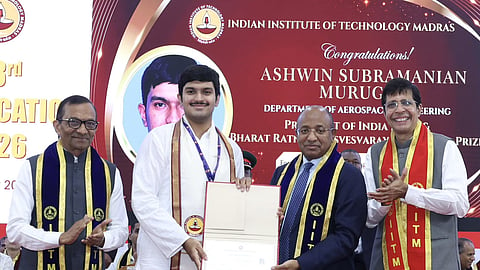
The convocation saw 3,518 degrees, including 511 PhDs, conferred on 3,106 students. The institute also unveiled the layout of the IIT Madras Zanzibar campus, India’s first international IIT, marking another milestone in its global outreach.
Describing IIT Madras as a global benchmark in engineering education, Mwinyi said the institute’s strength extended beyond research excellence to its ability to translate ideas into enterprises, employment and practical solutions. He said the Zanzibar campus symbolised a partnership founded on the belief that knowledge should transcend borders, bringing together students from India, Tanzania and several African nations under a shared pursuit of excellence.
Board of Governors Chairman Pawan Goenka said that the presence of the President Mwinyi at the convocation reflected the deepening partnership between India and Tanzania in higher education. Highlighting IIT Madras’s ecosystem, he added, “The institute has nurtured more than 560 startups with a combined valuation exceeding Rs 74,000 crore and produced globally recognised deep-tech ventures such as Agnikul Cosmos, GalaxEye and Ather Energy. This campus does not merely produce graduates and publish papers. It builds industries, creates jobs and turns research into enterprise.”
Presenting the director’s report, V Kamakoti, said, “IIT-M Zanzibar has emerged as an important higher education hub in East Africa, with 130 students, 51% of them from Tanzania, while the rest represent India, Kenya, Uganda, Ethiopia and Zambia. The inaugural M Tech batch has recorded 100% placements and the campus aims to expand enrolment to 350-500 students by 2027 through enhanced faculty strength, stronger industry partnerships and the development of East Africa’s first research-integrated Startup Studio.”
He also highlighted the launch of the IITM Global Foundation and new innovation hubs in Dubai and California as part of the institute’s vision of evolving into the world’s first multinational university.