
- Chennai
- Tamil Nadu
- India
- World
- EntertainmentEntertainment
- Business
- Sports
- Lifestyle
- Technology
- Videos
- Explainers
- Editor's Picks

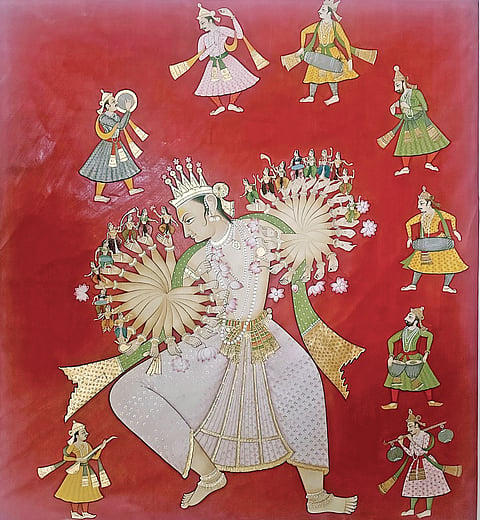
CHENNAI: What began as a temple backdrop has travelled far beyond the walls of Nathdwara temples in Rajasthan.
Pichwai paintings, traditionally created to depict festivals and celebrations around the deity Shrinathji, have today found a place in homes, galleries and contemporary art spaces.
Artist Yugdeepak Soni, who has been practising the art form for years, brings his interpretation of this centuries-old tradition to Chennai with his latest exhibition.
“Pichwai originated around 400 years ago in Nathdwara. Traditionally, it was a temple hanging. The paintings were made to depict different festivals and occasions and were placed behind Shrinathji, a form of Lord Krishna depicted as an eight-year-old child. The idea was that whatever celebration was happening outside, it should also be brought inside the temple for him. So, artists started depicting these occasions in paintings and hanging them inside the temple,” he adds.
What started as temple art gradually became a form practised by different artists and communities. Artists began experimenting with its motifs, techniques and materials, while keeping its traditional elements.
Today, Pichwai can be seen in homes and art spaces across the world. Its motifs have also found their way into contemporary art, interiors and design.
Yugdeepak’s paintings draw from Indian classical poetry, literature and mythology. He works with materials such as old paper, muslin and silk, using mineral, metallic and organic pigments. He is also trained in Mughal and Rajput painting styles and the Nathadwara Qalam style of Pichwai.
This is his fourth exhibition in Chennai.
“The horizon has opened up for Pichwai paintings. Now, you can see Pichwai motifs in almost every kind of artwork and design,” he says.
Yugdeepak says the response in Chennai has been encouraging.
“It is considered a sacred form of art, but it is also a very liberal form. The detailing and traditional methods used in Pichwai add to its appeal. Chennai’s architects and interior designers have also been using its motifs in new and innovative ways. People here have always been encouraging. The motifs, techniques and methods of Pichwai are very connecting, so it easily connects with people,” concludes the artist.
The exhibition titled Shri Pichwai is on view till October 30 at Forum Art Gallery, Adyar.