
- Chennai
- Tamil Nadu
- India
- World
- EntertainmentEntertainment
- Business
- Sports
- Lifestyle
- Technology
- Videos
- Explainers
- Editor's Picks

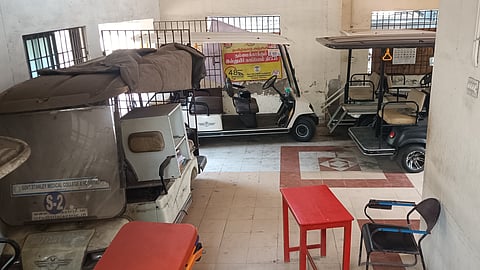
CHENNAI: Patients, senior citizens and persons with disabilities (PwDs) visiting Government Stanley Medical College and Hospital are facing difficulties navigating the sprawling campus as several battery-operated vehicles (BOVs) meant for their transport remain out of service.
The vehicles, donated to the hospital during the COVID-19 period, were introduced to help patients and visitors travel between outpatient blocks, wards, diagnostic centres and other facilities spread across the campus.
However, most of the nearly 10 vehicles supplied between 2019 and 2020 have become non-functional, reportedly due to battery failure. As a result, many patients, particularly those with mobility issues, are forced to walk long distances or depend on autorickshaws and two-wheelers to move between departments. Several of the idle vehicles can be seen parked near the hospital’s main entrance and along the pathway leading to the foot overbridge.
“Patients who are unable to walk find it extremely difficult to reach different blocks. Senior citizens and PwDs are the worst affected. Many visitors do not even know that a battery-operated vehicle service exists within the campus,” said Rajesh, a visitor to the hospital.
Stanley hospital, one of the State’s largest GHs, caters to thousands of patients and attendants every day. Visitors said that the lack of functioning transport vehicles has added to the hardship faced by those seeking treatment.
Hospital authorities said that the vehicles had been in operation for several years before their batteries weakened. A battery-operated vehicle currently costs between Rs 5 lakh and Rs 6 lakh, depending on its specifications.
“These vehicles were supplied during 2019-20. Around 10 remain with the hospital; 3 were repaired and put back into service about a week ago. The remaining are being assessed. Those found unfit for use will be disposed of as scrap after following the prescribed procedure,” a senior medical officer told DT Next. “Steps are being taken to assess the remaining vehicles and restore those that can be repaired to improve accessibility for patients within the hospital.”