
- Chennai
- Tamil Nadu
- India
- World
- EntertainmentEntertainment
- Business
- Sports
- Lifestyle
- Technology
- Videos
- Explainers
- Editor's Picks

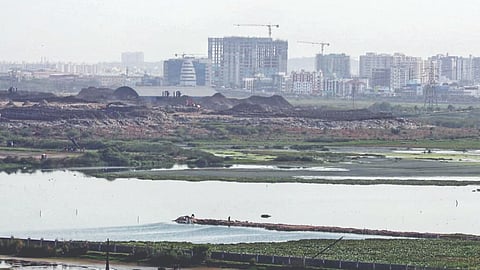
CHENNAI: Observing that wetland boundary demarcation exercise was under the Supreme Court's supervision, the Madras High Court declined to interfere with the National Green Tribunal's order imposing a one-km planning freeze around the Pallikaranai marshland Ramsar site.
The first bench comprising Chief Justice SA Dharmadhikari and Justice G Arul Murugan granted liberty to real estate developers and landowners to approach the Supreme Court seeking permission to implement the State Wetland Authority's revised proposal to restrict the buffer zone around the marshland to 128.19 hectares across 36 survey numbers.
The bench was hearing 13 writ petitions filed by CREDAI Chennai, Olympia Tech Park, Navin Housing and Properties, residents' associations, trusts, and private patta landowners, challenging the NGT’s September 24, 2025, order directing the Chennai Metropolitan Development Authority (CMDA) not to grant planning permissions within the Ramsar site and its one-km Zone of Influence until an Integrated Management Plan (IMP) is finalised.
The petitioners sought to quash the planning freeze and permit development in accordance with the Master Plan or, alternatively, direct the authorities to act on the Tamil Nadu State Wetland Authority's (TNSWA) revised interim proposal, restricting the buffer to 128.19 hectares across 36 survey numbers.
The bench held that while the petitions were maintainable, a legal impediment prevented it from granting the relief sought. According to the TNSWA, the identification, demarcation and ground verification of wetland boundaries across the country, including the Pallikaranai marshland, were pending before the Supreme Court in MK Balakrishnan v. Union of India.
Under the Wetlands (Conservation and Management) Rules, 2017, the Zone of Influence must be delineated from the notified boundary of the wetland. Until the marshland’s core boundary is verified on the ground and finalised under the Supreme Court's supervision, any attempt by the High Court to fix an interim buffer, exclude specific survey numbers, or dilute the protective freeze would run contrary to the apex court's ongoing monitoring, it noted.
The bench added that the issue of wetland boundary demarcation and ground verification was pending before the Supreme Court and that the delay could not justify passing orders conflicting with the apex court's supervision.
Also, the revised proposal submitted by the TNSWA on October 1, 2026, also made it clear that it was only tentative and that the final Zone of Influence could be notified only after the ground-truthing exercise was completed, it said.
Upholding the maintainability of the writ petitions, the bench granted the petitioners liberty to approach the Supreme Court through appropriate applications in the pending proceedings or by initiating fresh proceedings, seeking clarification, modification, or permission to implement the revised interim Zone of Influence proposed by the TNSWA.
It also directed the official respondents, particularly the TNSWA, the Directorate of Survey and Settlement, and the National Centre for Sustainable Coastal Management, to complete the ground-truthing, boundary demarcation, and statutory notification process in accordance with the Rules and Supreme Court directions. It then disposed of all the writ petitions.