
- Chennai
- Tamil Nadu
- India
- World
- EntertainmentEntertainment
- Business
- Sports
- Lifestyle
- Technology
- Videos
- Explainers
- Editor's Picks

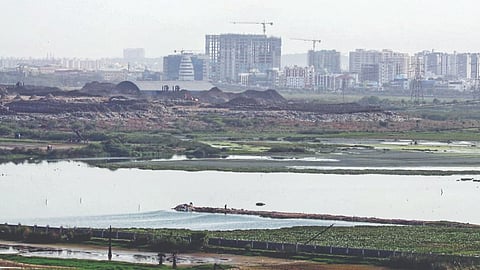
CHENNAI: The Confederation of Real Estate Developers' Associations of India (CREDAI), Chennai, has urged the Tamil Nadu government to withdraw the blanket 1-km development restriction around the Pallikaranai Marsh, arguing that the measure is unscientific, economically damaging and affecting more than 1.20 lakh lawful patta landowners.
Addressing a press conference in Chennai on Tuesday, representatives of CREDAI Chennai and several builders' associations said they support conservation of the ecologically significant Pallikaranai Marsh but opposed what they described as an arbitrary planning freeze imposed around the Ramsar site.
They called on the government to resume processing building approvals, No Objection Certificates (NOCs), individual plot applications and housing loans pending a scientific delineation of the wetland's influence zone.
Pointing out that the current restriction covers nearly 8,397 acres spread across 12 urbanised localities in South Chennai, including parts of the Sholinganallur corridor, one of Tamil Nadu's fastest-growing residential and commercial hubs, CREDAI claimed the freeze has disrupted construction activity, delayed infrastructure projects, and adversely affected thousands of property owners and businesses.
CREDAI Chennai vice president Viswajith Kumar said the dispute stems from the plan to expand the Pallikaranai wetland area, which was designated a Ramsar site in 2022. While the original 698-hectare Pallikaranai Swamp Reserve Forest, notified in 2007, remains legally protected and undisputed, he alleged that an additional 550 hectares were brought under the Ramsar boundary without adequate survey demarcation, ground verification, or public consultation.
He further claimed that four years after the Ramsar notification, the statutory process prescribed under the Wetlands (Conservation and Management) Rules has not been completed. Citing an RTI reply dated February 25, CREDAI said the Integrated Management Plan (IMP) prepared by the Care Earth Trust is still in draft stage and remains under examination by the National Centre for Sustainable Coastal Management (NCSCM).
Arguing that enforcing a uniform 1-km development buffer around the wetland does not align with scientific principles or existing environmental guidelines, it said the National Green Tribunal's (NGT) observations indicate that a wetland's zone of influence should be determined based on hydrology, topography and surrounding land use rather than by applying a standard radial distance.
CREDAI also referred to a site-specific approach by the authorities in the East Kolkata Wetlands that allowed urban development while protecting the site's ecological character.
It said nearly 1.20 lakh patta landowners within the 1-km radius are facing uncertainty as they are unable to obtain approvals to construct houses, redevelop existing properties or complete property transactions. It added that banks and housing finance companies have either delayed or withheld loan sanctions because of the regulatory uncertainty.
Estimating that projects and businesses worth approximately Rs 51,735.88 crore have been affected, it claimed that the restriction could result in a direct government revenue loss of about Rs 10,995.38 crore and an indirect economic impact of Rs 8,795.10 crore, taking the total estimated economic impact to Rs 19,790.48 crore. It also warned that the slowdown could affect employment in the construction sector.
Besides private developments, the association said several public infrastructure projects, including 15 stations under CMRL phase 2, two existing MRTS railway stations and the proposed integrated transit hub at Sholinganallur, also fall within the notified 1-km zone.
Government offices, health centres, hospitals, schools, post offices, electricity and Metro Water facilities, research institutions and other civic infrastructure are also located within the affected area, it said.
CREDAI Chennai urged the state government to withdraw the blanket restriction until scientifically validated wetland boundaries are finalised. It also sought completion of ground-truthing studies, hydrological assessments, publication of survey maps and formal approval of the IMP after stakeholder consultations. Pending completion of the process, the association requested the government to permit the processing of existing planning approvals, plot applications, NOCs and project finance proposals.