
- Chennai
- Tamil Nadu
- India
- World
- EntertainmentEntertainment
- Business
- Sports
- Lifestyle
- Technology
- Videos
- Explainers
- Editor's Picks

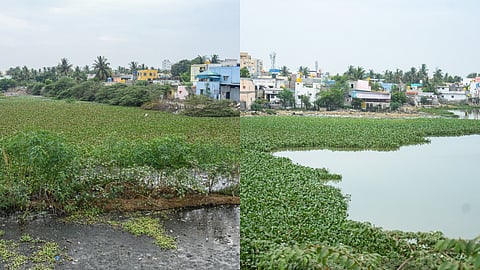
CHENNAI: Pallavaram Periya Eri, one of the largest and most important waterbodies along the 14.3-km Pallavaram-Thoraipakkam Radial Road, is facing severe environmental degradation due to sewage pollution, encroachments, dumping of construction waste, and the unchecked spread of water hyacinth.
Once serving as a major freshwater source for the belt, the lake has now turned into a sewage-filled water body, with large portions of its surface covered by dense mats of water hyacinth.
Activists warn that the deteriorating condition of the lake is threatening its ecological balance and water storage capacity. The lake is fed by three major inlets originating from the Tirusulam Hills, Tiruneermalai through Moongileri, and Veeraraghavan Lake via Chromepet. However, these natural water channels are being affected by pollution and encroachments, reducing the lake’s ability to receive and store rainwater effectively.
Activist Syed Shamsudeen lamented, “Several residential and commercial buildings around the lake are discharging untreated sewage directly into the waterbody. Construction debris and other waste materials are being dumped along the lake’s periphery, particularly on the side facing the Radial Road, further shrinking the water spread area and affecting the lake’s ecosystem.”
Historical records indicate that the lake once spread across nearly 150-200 acres. However, due to years of encroachments, siltation, garbage dumping and unregulated development, the effective water spread area has reduced to less than 50 acres.
Activists fumed that illegal constructions have occupied significant portions of the lake and its feeder channels, affecting natural water flow and increasing the risk of flooding during monsoon seasons. Residents and activists have urged the authorities to take immediate action by stopping sewage discharge, removing encroachments, clearing water hyacinth, desilting the lake and restoring its original water-holding capacity. They stress that protecting Pallavaram Periya Eri is crucial for groundwater recharge, flood mitigation and preserving one of the region’s key water resources.
When contacted, Tambaram Corporation Commissioner S Balachander, told DT Next: “There are 1,100 encroachments in the lake. Only after removing them, the lake can be saved. Earlier, notices were issued for the buildings to be demolished, but later there was no development. Since the lake comes under the control of WRD, they should be working on removing the encroachments. From our end, we’re taking steps to restore the lake.”