
- Chennai
- Tamil Nadu
- India
- World
- EntertainmentEntertainment
- Business
- Sports
- Lifestyle
- Technology
- Videos
- Explainers
- Editor's Picks

CHENNAI: The State government’s decision to induct only AC electric buses in future fleet additions has raised concerns among passengers and transport activists, who are seeking clarity on fares and the future of free and concessional travel if ordinary buses are gradually phased out.
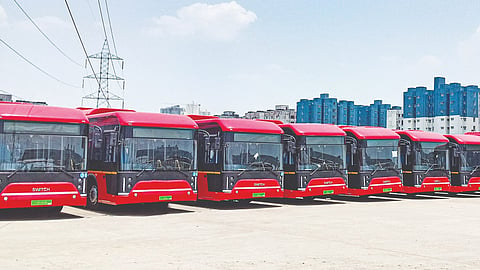
The move follows Chief Minister C Joseph Vijay’s direction to the transport department to procure only electric AC buses. State transport corporations are expected to add around 2,000 such buses under the Gross Cost Contract (GCC) model.
While commuters have welcomed the prospect of more comfortable travel during Tamil Nadu’s scorching summers, many have questioned whether beneficiaries of free travel and concession schemes will continue to enjoy the same benefits if future fleet additions comprise only AC buses.
Passenger organisations have urged the government to announce its fare and concession policy before proceeding with large-scale procurement.
Under the Vidiyal Payanam Thittam, women are entitled to free travel only on ordinary fare city and town buses. Although the TVK government has promised to extend the scheme to all bus categories, the proposal has yet to be implemented. Similarly, students holding free bus passes can travel on all bus categories except AC services.
Fare concessions for senior citizens and differently abled passengers are also not applicable on AC buses.
Transport officials, however, believe the transition is financially feasible under the GCC model as the operating cost difference between AC and non-AC electric buses has narrowed significantly. Under the model, private operators own and maintain the buses while transport corporations pay a fixed per-km charge, eliminating the need for heavy upfront capital investment.
The Metropolitan Transport Corporation (MTC) has already procured 625 low-floor electric buses under the GCC model in phase 1 of the World Bank-supported scheme. The contract fee works out to Rs 77.17 per km for non-AC electric buses and Rs 80.86 per km for AC electric buses, a difference of just Rs 3.69.
With the operating cost gap shrinking, officials believe large-scale induction of AC buses is economically viable. Passenger groups, however, argue that the government must simultaneously clarify the future of welfare schemes so that women, students, senior citizens, differently abled passengers and other beneficiaries are not left disadvantaged by the transition.
MTC has awarded a contract in phase 2 to procure 750 electric buses, including 500 AC electric buses. Ahead of the Assembly elections scheduled for March, MTC floated tenders to procure another 1,000 electric AC buses under the GCC model. The bids are yet to be opened.
At present, MTC operates its newly inducted low-floor diesel and non-AC electric buses under the deluxe fare category, while low-floor electric AC buses are operated under AC fares. The minimum fare is Rs 5 for ordinary buses, Rs 7 for express buses, Rs 11 for deluxe buses and Rs 15 for AC electric buses.
V Rama Rao, president, Federation of Senior Citizen Associations of Tamil Nadu, said that procuring only AC electric buses would effectively deny concessions to several categories of passengers. “No travel concessions are available on AC buses. What will happen to existing beneficiaries such as women, trans persons, senior citizens and students?” he asked.
KP Subramanian, retired professor of urban engineering, Anna University, urged the government to reconsider procuring only AC e-buses and continue inducting ordinary buses to serve economically weaker sections that depend on public transport for their daily commute.
“Converting AC buses into ordinary fare services with the existing welfare schemes will not be financially viable for transport corporations,” he opined. “What we need are ordinary buses for the common people. AC bus fares are too high and will not be affordable for many commuters. The debt-ridden transport corporations could face additional financial strain if fare concessions are extended without adequate support.”
Transport department officials said that all the concessions would continue without any hindrance in the future too and declined to clarify further.
Ordinary bus: Rs 5-24
Express bus: Rs 7-35
Deluxe bus: Rs 11-49
AC bus: Rs 15-80