
- Chennai
- Tamil Nadu
- India
- World
- EntertainmentEntertainment
- Business
- Sports
- Lifestyle
- Technology
- Videos
- Explainers
- Editor's Picks

CHENNAI: A coalition of residents’ welfare associations (RWAs), conservation groups and civil society organisations has called for a basin-level plan to protect the Pallikaranai watershed, blaming outdated water policy, encroachments, sewage pollution and poorly coordinated infrastructure works for worsening floods and water stress.
The demands are part of a Citizen’s Charter for the Pallikaranai Watershed compiled by the Chennai Wetlands Action Collective (CWAC) and Oorvani Foundation.
The Pallikaranai Collective report, released on Wednesday, sought coordinated action by government departments.
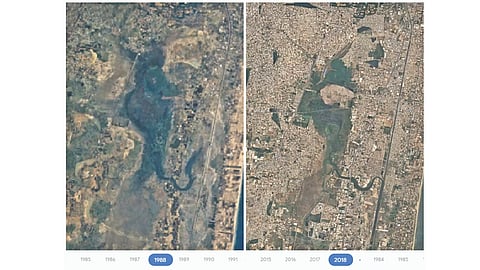
The 306 sq km watershed has a cascade of 65 major lakes and hundreds of ponds. A study cited in the charter identified 452 water bodies, of which 165 have been lost.
K Raju of CWAC said that the absence of an updated state water policy for more than 30 years was a key reason for recurring floods.
“Tamil Nadu’s last official water policy was in 1993. Despite the Union government updating the policy in 2002 and 2012, Tamil Nadu has not updated it for over 30 years. This remains a primary root cause of recurring flood disasters,” he opined.
The charter seeks enactment of a Flood Plain Zoning Act, public release of the Thiruppugazh Committee’s flood mitigation report and special development regulations for the Chennai Metropolitan Area.
It also calls for an urban policy integrating water management, biodiversity and climate resilience.
The groups have demanded protection of the Pallikaranai Marsh, which they said has shrunk from 6,000 hectares to 600 hectares.
About 250 sq km of south Chennai drains through the marsh, which supports more than 200 bird species and 18 species of international conservation significance.
The charter seeks enactment of a Flood Plain Zoning Act, public release of the Thiruppugazh Committee’s flood mitigation report and special development regulations for the Chennai Metropolitan Area
They want encroachments and infrastructure inside the Ramsar site, its buffer zone and floodplains removed, and have opposed restoration works involving concretisation or construction that alters natural water flows.
Poor coordination between government agencies came in for particular criticism.
Harsha Koda, co-founder of the Federation of OMR Residents Associations (FOMRRA), alleged that Thangal Lake was restored for Rs 5.5 crore under CSR funding, in collaboration with an NGO and the Greater Chennai Corporation.
“Five days after its inauguration, Chennai Metro Rail Limited demolished the restored bunds for construction work. This clearly shows the lack of coordination with departmental works,” Koda said.
Udhay Raj of Oorvani Foundation said lake boundaries should be fixed based on survey records rather than reduced water-spread areas.
“There should be standard operating procedures for NGO-led restoration projects, including mandatory measures to address sewage inflows and connectivity,” he pointed out.
The charter calls for all 24,684 wetlands identified by ISRO in Tamil Nadu to be ground-truthed, mapped and protected, with at least 50-metre buffer zones.
It also seeks scientific, catchment-based planning of stormwater drains and regular desilting of natural canals.
The groups have opposed further use of cut-and-cover canals wherever possible, citing difficulties in desilting and concerns over their flood-carrying capacity.
The charter notes that Chennai generates more than 850 MLD of sewage against treatment capacity of about 745-750 MLD across 22 CMWSSB plants.
It seeks decentralised sewage treatment, strict action against untreated sewage discharge and GPS monitoring of sewage tankers.
For Buckingham Canal, the Collective has demanded desilting of the full 13-km stretch within the watershed and removal of encroachments from adjoining floodplains.
It has also called for scrapping the proposed Uthandi escape channel, citing its location in a primary aquifer recharge zone and the Coastal Regulation Zone.
The Collective has proposed an independent interdepartmental committee comprising experts and people’s representatives to examine the gaps and prepare a time-bound implementation plan fixing responsibilities for each department.