
Chennai
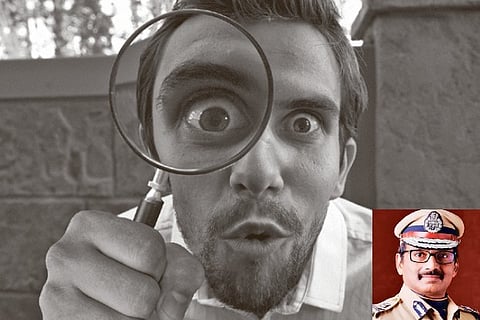
If he were alive today, his ever-famous detective Sherlock Holmes would have commenced cracking tricky cases with ease by obtaining microscopic traces of bacteria left behind by criminals at the scene of the crime.
When we are born, we are mostly sterile but acquire microbes from our mother and our immediate environment during the birth and after the birth. We gradually amass approximately 10,000 different bacterial strains and the species composition remains mostly stable for the rest of our lives. We start with around 20,500 genes at birth but we acquire more than 10,00,000 genes over time due to the microbiome. We have 10 times more bacterial cells in our bodies than human cells, which leaves us marvelling if we were more of a microbial being than a human being.
Police officers could soon have a new tool to detect crimes and capture criminals. “We all have microbes living on us, no matter how much we clean ourselves. Research divulges that every individual’s microbial community or microbiome is as unique as human fingerprints or DNA. We slough off millions of microbial cells every hour into our surroundings, so we’re leaving our microbial signature wherever we go.”
Microbiologist Jose Lopez and Jack Gilbert, PhD, the Microbiome Centre faculty director at the University of Chicago, organised mock burglaries as part of an experimental project. After the burglary, the forensic experts swooped on the scene to swab down surfaces, handles and houses. After eliminating the bacterial signatures left behind by the household inmates and the pet cat, investigators had new physical evidence of burglars in the form of their microbial signatures.
The bacterial signatures of the two intruders did not just reveal their identity, it also told their lifestyle habits when investigators stacked up against a database of a few thousand people. The comparison divulged that one of the burglars had at least 10 alcoholic drinks a week while the other was on migraine medication. The microbiome left at the scene could also speculate whether the perpetrator is a man or a woman, their weight, ethnicity, whether they smoke or drink, etc. These kinds of leads could be precious for the police.
A study published in 2010 in the “Proceedings of the National Academy of Sciences” illustrated that DNA recovered from computer keyboards and owners’ fingertips matched. The authors could also scrape out bacteria from nine computer mice and correctly pinpoint the owners by contrasting it with a database of 270 microbiomes available in the public domain. Everybody’s faeces has a unique signature. Harvard University conducted a study on stool samples collected from participants. A year later, they found the bacteria signatures collected from the participants’ stools helped researchers identify individuals with 86 per cent accuracy. Skin bacteria are found on mobile phones, too. Investigators can use the microbial profile of a person obtained from the cell phone to link it to its owner with 97 per cent accuracy using only swabs.
Microbes play an essential role in the decomposition of a human corpse. Scientists are exploring microbial succession during the decomposition to estimate the time since death and as an indicator for locating unknown graves. In a healthy human being, the brain, liver, spleen and heart are free from microflora. Our immune system hinders the microbes from getting into these organs. But after death, microorganisms spread into these germ-free organs. The migration of microbial microorganisms into the sterile organs can be a pretty accurate measure of post-mortem interval. This duration enables investigators to arrive at the time of death.
The microbial signature technique could become a new tool in law enforcement’s arsenal alongside DNA fingerprinting and physical fingerprinting. When the physical fingerprints are smudged or if the suspect has not left behind DNA, bacterial fingerprints can be at the investigator’s aid, although DNA will always be the gold standard. Bacterial signatures have several advantages over diagnostic DNA evidence. Unless the suspect has left behind blood, tissue, semen, saliva, hair etc., it is often difficult to obtain sufficient DNA for forensic identification. On the contrary, microbes are abundant and it’s much easier to recover bacterial DNA than human DNA. It is also easier to recover bacterial DNA than human DNA from touch surfaces, and on the other hand, bacterial DNA is available in most scenarios than human DNAs. Cosmetics, antibiotics usage, dietary changes and health states could have a corresponding change in the microbiome, which could be one of the drawbacks of bacterial signatures.
While human bacterial fingerprinting should never replace traditional DNA fingerprinting, it could augment the forensic scientists’ existing techniques. Any introduction of a new approach would require amendments to criminal laws and the creation of standards governing samples’ collection and use. Aubstantial investment would be needed to standardise and implement detection techniques to automate and hasten microbiome profiling. And could entail maintenance of databases which could raise privacy issues. As the databases could reveal if a person is carrying a sexually transmitted disease or suffering some other chronic illness, it could also show his associations, the number of sexual partners they have had, and his drug habits and addictions. The police could use such a database to connect people to crime by showing evidence by way of the places he has visited, his familial origin, ethnicity etc.
Finally, the spooky truth is that we are more bacteria than human cells. All the microbes in our body have a vibration and frequency. Our consciousness is not just affected by what’s going on behind our eyes. Many influences are beyond the realm of our awareness, the human microbiome being one of them. Therefore, we must work in participation with our entire body, including the microbiome, to evolve beyond our current physical and mental conditions and make a spiritual connection with all of life.
— The author is ADGP, Law and Order
Visit news.dtnext.in to explore our interactive epaper!
Download the DT Next app for more exciting features!
Click here for iOS
Click here for Android