
- Chennai
- Tamil Nadu
- India
- World
- EntertainmentEntertainment
- Business
- Sports
- Lifestyle
- Technology
- Videos
- Explainers
- Editor's Picks

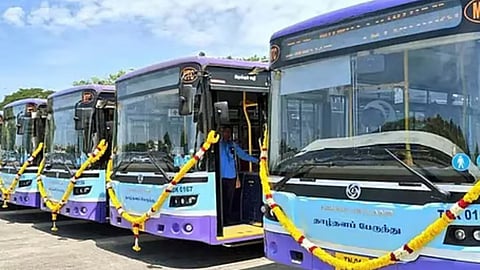
CHENNAI: A city-wide survey by Chennai Unified Metropolitan Transport Authority (CUMTA) and Chennai Metro Rail Limited (CMRL) is underway to finalise routes for 220 electric low-floor buses to provide first and last mile connectivity to the Metro stations, with rollout targeted by December 2026.
The survey asks users to provide key details: their starting location, the Metro station they board, the mode of travel used to reach the station and the time taken, and their destination station along with how they complete the journey. Additional suggestions can also be given if there are any specific needs, say, wheelchair requirements etc.
Hosted on the Chennai One app, it is aimed at refining feeder routes that have already been mapped for Metro stations. “This survey is for refining those routes. What we have now is based on station surveys, which only capture Metro travellers,” said Jeyakumar, member secretary, CUMTA.
The proposed network comprises 220 feeder vehicles, with tenders already floated and award expected after the Assembly elections. “Services are targeted to begin by December 2026,” he added.
The first and last mile connectivity services will be operated under the gross cost contract basis. The proposed fleet comprises 70 numbers of 7-metre electric low-floor AC buses, and 150 numbers of 5-metre electric low-floor AC buses. MTC will operate the buses for the CMRL.
The system will cover Metro stations and their surrounding areas, broadly within 5 km radius. Around 20 vehicles are expected to be deployed per station, depending on demand and coverage.
Planning is focused on areas that currently lack bus connectivity. “The intention is to move away from arterial roads and instead serve neighbourhood interiors, such as Nanganallur where access remains limited despite proximity to major corridors,” noted Jeyakumar. “Overlap with existing bus routes will be capped at around 30% to avoid duplication. Routes will not be fixed at launch and will be adjusted based on usage. It will be a permutation and combination initially. After a review in a week or 10 days, we’ll formalise it.”
The long-term aim is to establish predictable feeder services with fixed timings, enabling commuters to plan trips around them. He also urged residents to participate in the ongoing survey, noting that wider input would improve route planning and service effectiveness.