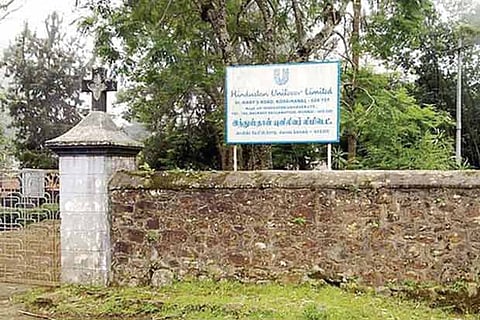

Chennai
In March this year, Unilever’s CEO Paul Polman claimed that since operations ceased in March 2001, the removal of all mercury bearing material in 2003, and subsequently the decontamination and safe disposal of plant, machinery and materials used in thermometer manufacturing in 2006, have removed any risk of contamination.
However, samples from two stream beds within the Pambar Shola Reserved Forest, taken in April 2016 and analysed by the Department of Atomic Energy, revealed mercury levels higher than USEPA and Canadian health-based standards for sediment. Activists say that both the streams emanate from Unilever’s site.
The USEPA specifies a range of 0.23 to 0.83 mg/kg, while Canada stipulates a range of 0.17 to 0.49 mg/kg. The three samples contained 0.96, 4.67 and 8.96 mg/ kg respectively. Uncontaminated sediments contain less than 0.1 mg/kg of mercury. The most contaminated sediment contained nearly 11 times more mercury than the higher end of the USEPA standard, and more than 18 times the Canadian safety levels.
At 0.96 mg/kg, the least contaminated sample too exceeded the higher end of the safe ranges prescribed in the US and Canadian jurisdiction, said experts. Alarmed by this, about 60 fence-line residents have since come together as St Mary’s Road Residents Welfare Association to insist on a thorough clean-up.
Navroz Mody, a longtime resident of this area and a member of TNPCB’s Local Area Environment Committee, said: “The levels of mercury found outside the factory are proof of Unilever’s negligence and insistence on a substandard clean-up is actively harming Kodaikanal forests. Unilever’s Detailed Project Report does not even acknowledge locals as a stakeholder. Naturally, as neighbours of the site, we are worried that the contaminated site will affect us.”
Raj Mohan, Secretary of Tamilnadu Alliance Against Mercury (TAAM), said they want the forest area notified as part of the Kodaikanal Wildlife Sanctuary. “We want the mercury clean-up done to 0-0.2 mg mercury level but the TNPCB said that clean-up of 8-10 mg is only possible. We are strictly against this. Once the clean-up has been effectively done, we want the Unilever campus shut up and not used for anything.
The high mercury level has not only affected the workers of this plant but also residents in the Upper and Lower Palani region. We want a hospital in the region to treat ailments caused by mercury poisoning. People are prone to kidney disorders, brain tumours, skin and gum diseases, and children too are born with complications,” he explained. Unilever’s Kodai exploits took a dark turn, after an RTI to TNPCB revealed that the conglomerate’s Hazardous Waste Authorisation licence expired in March 2011.
“There is no further renewal of authorisation and the hazardous waste stored inside the factory is illegal and unlicensed,” said Nityanand Jayaraman, Advisor, Community Environmental Monitoring.
Visit news.dtnext.in to explore our interactive epaper!
Download the DT Next app for more exciting features!
Click here for iOS
Click here for Android