
- Chennai
- Tamil Nadu
- India
- World
- EntertainmentEntertainment
- Business
- Sports
- Lifestyle
- Technology
- Videos
- Explainers
- Editor's Picks

CHENNAI: After more than a month of dance and music events, the Margazhi season is drawing to a close. While concerts continue to dominate the calendar, lecture-demonstrations (lec-dems) also drew steady interest this year, especially from rasikas keen on exploring the academic side of music.
Scholar and writer Dr Chithra Madhavan, a regular host of lec-dems, explains that these sessions are rooted in deep research, aimed at unpacking the intricacies of Carnatic music. “It is not possible to present a lec-dem without profound research. The audience is knowledgeable, and when questions come at the end of the session, the speaker must be equipped to answer them,” she says.
Attendance, she notes, has grown steadily in recent years. “The response to my lec-dems this year was amazing. There is definitely more awareness and interest now. That said, lec-dems cannot be compared with concerts in terms of numbers. Lec-dems are niche.”
Lec-dems draw smaller audiences in part because of the detailed, academic nature of these sessions.
Unlike a concert, which you can enjoy passively, a lec-dem requires attention and some familiarity with Carnatic music. Without that background, it can be hard to follow the discussions and demonstrations
Chitra
Timing is another factor. Most lec-dems during the Margazhi season are scheduled in the mornings, making it difficult for students, working professionals, and homemakers to attend. “That’s another reason why the turnout is smaller,” Chithra says.
At the same time, recording and uploading sessions online has broadened their reach, allowing many to listen later at their convenience.
Young musician Archana Murali, who has performed in the Margazhi season for several years, says lec-dems are valuable both for learning and for connecting with artistes.
They offer a chance to hear musicians and experts talk about their art outside a concert. That itself is refreshing. For students of music, lec-dems provide insights that can be applied in their own practice. I always take something away from a lec-dem. If something resonates with me, I try to incorporate it into my next concert.
Archana Murali
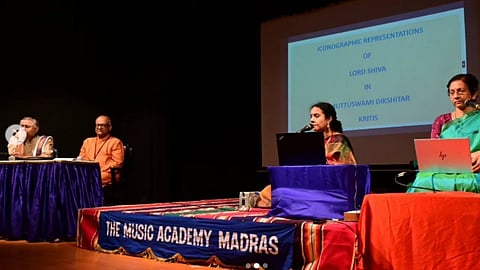
Archana points out that several sabhas now actively curate lec-dem series. She cites the Music Academy’s December 2025 sessions, which were themed around the 250th birth anniversary of Muthuswami Dikshitar, as an example.
Theme-based demonstrations like these offer a deeper perspective on music. For young musicians, these sessions can be formative, providing inspiration, new ideas, and a deeper understanding of the craft. For older rasikas, they offer an opportunity to engage more deeply with a tradition they love
Archana
The youngster observes that the audience turnout often depends on the artiste leading the session. Senior rasikas make up the majority of attendees, while younger audiences are mostly musicians seeking in-depth knowledge. “Young rasikas are largely missing, but I hope this will change over time.”
Lec-dems have evolved over the years, in both form and reach. They are no longer confined to the Margazhi season, with independent organisations hosting sessions throughout the year at various venues.
“Despite their niche appeal, the increasing interest and broader accessibility of lec-dems suggest that they are becoming an integral part of the Margazhi experience. Whether attended in person or watched later online, they allow music lovers to pause, reflect, and appreciate the layers of complexity behind every note and composition,” concludes Archana.