
- Chennai
- Tamil Nadu
- India
- World
- EntertainmentEntertainment
- Business
- Sports
- Lifestyle
- Technology
- Videos
- Explainers
- Editor's Picks

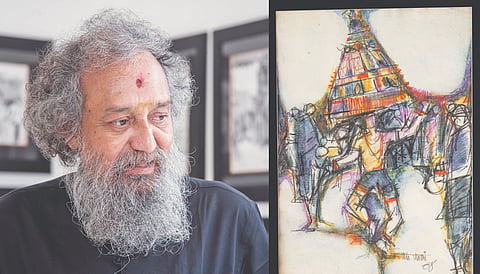
CHENNAI: Widely recognised for his contribution to Indian cinema as an art director and production designer, Thota Tharani has spent more than five decades exploring another creative world through painting, drawing, printmaking and murals. A retrospective celebrating 57 years of his artistic practice brings together this journey, offering viewers an opportunity to discover the artist beyond the film sets. Presented by Artworld – Sarala’s Art International, Thota Tharani: A Retrospective – 1969 to Present will be held at Lalit Kala Akademi from October 24 to 30.
Tharani’s artistic vocabulary has evolved through experiments with colour, form, line, texture and composition. His works draw inspiration from nature, architecture, Indian traditions, mythology, music and everyday life. From early watercolours and figurative explorations to increasingly abstract compositions, his practice reflects a willingness to move between subjects and mediums.
Rather than follow a fixed style, Tharani prefers to allow each phase of his work to develop naturally. “I don’t think about how my work has evolved, because that could stop the flow of my paintings. I prefer to let things develop naturally and do what I want,” he says.
He also avoids returning to the same subject for too long. Each series has its own identity, allowing him to revisit familiar themes later with a different perspective and technique. “I work on different kinds of paintings, each with its own subject, so that my work does not become repetitive,” he explains. Even when he returns to a subject after several years, he approaches it differently, enjoying the freedom to experiment with new applications and ideas.
Tharani often works on a series until he has produced around 50 to 100 paintings before moving on to another subject. Returning to a theme later allows him to approach it with a different idea or technique, rather than repeat an earlier treatment. He returns with a fresh perspective.
This independence is central to how he distinguishes his painting practice from his work in cinema. While filmmaking involves creating visuals for directors, cinematographers and producers, painting is a more personal pursuit. “I feel that the painting is yours and the film work is for somebody else. But still, you have to have your soul and thought into the subject, into the painting or to the film side,” he says.
His experience in cinema has brought him wider public recognition, but Tharani says the two practices follow different approaches. While his work in films involves creating visuals for directors, cinematographers and producers, painting is a more personal pursuit. His Kayadu cinema series is an exception to his usual practice of keeping the two worlds separate.
“I don't consider films and painting to be the same. Films are of a different approach and painting is of a different approach. The work I do in the film industry is for other people, like directors, cameramen or producers, but the painting is done purely for me. I don't think I should be concerned about whether one person likes my painting or another doesn't. Once you do your painting, you know what is coming out of it and you understand it better. I feel that the painting is yours and the film work is for somebody else,” he says.
Music has also played a significant role in his artistic journey. A lifelong listener, Tharani recalls being drawn to film background scores from the 1960s and 1970s, remembering the composers, conductors and musicians behind them. His interest extends to Western classical composers such as Bach, Beethoven and Brahms, as well as composer Andrew Lloyd Webber.
This fascination eventually found expression in his Symphony series, among his most colourful bodies of work. The series grew out of his longstanding engagement with music and allowed him to experiment with colour on a large scale. “That is where the symphony series were born,” he says, describing the works as some of the most joyful paintings he has created.
His relationship with materials is equally exploratory. Whether working with pencil, oil pastels, watercolours or murals, he believes each medium demands a different approach. He is also open to finding inspiration in subjects that might otherwise appear ordinary.
“Anything can become a subject for you, the way you look at it. There is no particular rule that an artist has to follow. Some people may focus on rocks, while others may work repeatedly with seascapes. For me, I take every subject, and it automatically interests me. There is no rule that I have to paint a cup and saucer today. Anything can become a subject for me and I take it happily and do my painting,” he tells us.
His early experiments with watercolour also shaped his subsequent direction. In 1968, when he was preparing to apply for the National Exhibition of Art, one of his teachers told him that his realistic watercolour would not be suitable for the exhibition. The experience prompted him to explore a more decorative approach. “It was a very realistic kind of work. That affected me for some time and I wondered what I should do for the next show. For the Mysore Dasara exhibition, I created a decorative watercolour and won first prize in modern decorative painting,” he recalls.
His first exhibition at Sarala’s Art Centre followed in 1970, featuring watercolours made using a different technique. A show in Bombay followed in 1971. Over the years, Tharani has held approximately 135 solo exhibitions, many of them independently organised.
He typically works on a series before moving to another subject, returning to earlier themes when he feels ready to approach them differently. This process allows him to experiment without repeating an earlier treatment. “I do about 50 to 100 paintings in a series. Each series will have around 100, and then I leave it and don't continue with it for a long time. I move to another subject and do another 50 or 100 paintings before moving to a third one. When I come back to the first subject, I enjoy it again because my concept, visual approach and application will all differ. You don't have to force yourself to sit under a tree and talk philosophy about your work. It is just about enjoying yourself and doing the work,” he says.
The exhibition holds special significance for Artworld – Sarala’s Art International, whose association with Tharani dates back to his early career. Sarala’s Art Centre presented his works on several occasions during the 1970s and early 1980s, making the retrospective a continuation of a longstanding relationship.
Despite his extensive body of work, Tharani believes there is still much to discover. He remains reluctant to predict what he might explore next, preferring to let each body of work develop on its own terms. “I don't think I've explored enough. I still have the urge to explore a lot more, so I can't tell what I'm going to do next. Until I finish the work, I won't exhibit. This is how I am,” he smiles.