
- Chennai
- Tamil Nadu
- India
- World
- EntertainmentEntertainment
- Business
- Sports
- Lifestyle
- Technology
- Videos
- Explainers
- Editor's Picks

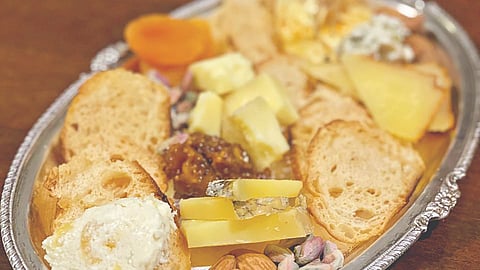
CHENNAI: For many, cheese begins and ends with a familiar slice or cube. But in Chennai, artisanal cheese makers are experimenting with Indian milk, local ingredients and techniques borrowed from centuries-old cheesemaking traditions. At the centre of that journey is Kase, a Chennai brand founded by Namrata Sundaresan and Anuradha Krishnamoorthy in 2016. Kase did not begin as a conventional food business. The founders initially explored cheesemaking as a way of creating skills and livelihood opportunities for differently abled women. Their early years were spent experimenting, doing pop-ups and learning about milk, farms, breeds and sourcing before the craft itself became the business.
Today, Kase's cheeses have earned international recognition, including a Bronze for Lavender Fields at the 2022 World Cheese Awards and a Silver for an Alpine-style washed-rind cheese in 2023. But for Namrata, the significance lay less in the medals and more in what they made possible. “Instead of asking, ‘Can we make cheese in India?’, we could ask, ‘What kind of cheese can we make because we are in India?’”
Unlike European regions where cheesemaking developed alongside local climates, milk and microbial environments over generations, Chennai's heat and humidity present a different set of challenges. Temperature and humidity can affect fermentation, moisture loss, rind development and ageing. But rather than attempting to recreate a European cheese exactly, Namrata says, “You cannot simply reproduce a European recipe and expect the same result. You have to understand the principle behind the style and adapt it to your milk, climate and conditions.”
For Chef Goku, who has worked with Kase across collaborations and pop-ups, that distinction matters. “The idea should be to understand the technique and then see what happens when that technique meets Indian milk, Indian climate and Indian terroir.”
And that experimentation can result in cheeses that look beyond the conventional cheese board.
What happens after the milk enters the cheesemaking room is perhaps the part consumers see least. Depending on the style, the curd is worked, drained or pressed, salted and then moved into an ageing environment. There, the cheese is turned, washed, brushed and monitored as microorganisms and enzymes change its flavour and texture.
Namrata says ageing can range from three days to three years, depending on the cheese. A Parmesan-style cheese, for instance, may require years to develop its final character. And perfection isn't necessarily achieved in one attempt.
“Some cheeses have gone through dozens of iterations, and even then I wouldn't say there is a final version. Cheese can teach you something every season.”
One of the cheeses that stayed with Chef Goku is Rice Fields, a washed-rind cheese whose rind is washed using rice kanji water. He once paired it at a Kochi pop-up with a salad of vallarai, forest ferns, siru kilangu and coconut, dressed with kadaranga lime. The combination worked because the cheese didn't have to stand apart from the food.
“Indian cuisine already has so much fermentation, acidity, spice, bitterness, sweetness and texture. Cheese can become another layer within that language rather than something that sits separately on a cheese board,” says Goku.
He also points to Mor Milagai and Banon with lotus leaves as examples of cheeses where local ingredients become part of the cheese's identity.
For Chennai's cheese enthusiasts, the difference is increasingly apparent. Suneethi Raj, founder of LocalXO, says, “Processed cheese is generic,” noting that it has its place in nostalgic dishes such as chilli cheese toast and Indian-style sandwiches. But for pasta, pizza or eating cheese plain, she finds that artisanal varieties offer a completely different texture, flavour profile and mouthfeel.
Her advice to newcomers? “The ingredient list — look for varieties free from emulsifiers and preservatives.” She says education, access and price remain barriers to artisanal food, though Chennai's audience for such products has grown through food markets, supper clubs and pop-ups.
Shreeya Jayaraman, who discovered a wider world of cheese while studying in Wisconsin, puts the appeal more poetically: “A cheese holds memories of what it’s been through and tells its story on your palate.”
Having eaten Käse for nearly a decade, her favourite is its pickled feta. She also points to its idli podi cheddar and kimchi-infused cheese, describing Käse as a home-grown brand that is “bringing the world to Chennai and Chennai to the world.”
Chef Goku sees the shift from the perspective of someone working with these cheeses in a kitchen. He says Kase has helped introduce customers to the idea that cheese doesn't have to mean only familiar imported varieties. “I’ve seen people who started as customers become interested enough to eventually explore cheesemaking themselves. The next step is not just convincing people that Indian cheese is as good as European cheese. It’s getting people to say, ‘I want this because it is Indian cheese,’” says Chef Goku.
Artisanal cheese remains a premium product. Namrata says processed industrial cheeses can cost around Rs 350–600 per kg, while Kase's natural cheeses range from approximately Rs 2,300 to Rs 6,000 per kg, depending on the variety and ageing.
Price is a factor, she says, but not the only one. Awareness and familiarity also determine whether consumers seek out artisanal cheese.
Kase primarily sells through its online store and select partner outlets, while tasting opportunities are available through events and open houses. The brand also supplies the hospitality industry, including hotels, as part of its B2B business.