
- Chennai
- Tamil Nadu
- India
- World
- EntertainmentEntertainment
- Business
- Sports
- Lifestyle
- Technology
- Videos
- Explainers
- Editor's Picks

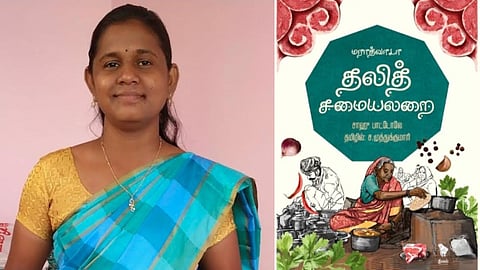
CHENNAI: A review she wrote last year of Dalit Kitchens of Marathwada for Neelam magazine set Muthukumari S on the path to translation. The 36 year-old government schoolteacher went on to translate the English version of Shahu Patole’s Marathi book into Tamil as Marathwada Dalit Samayalarai.
The book, published by Neelam Publications, was launched on January 17 at the 49th Chennai Book Fair. Drawn to the book’s focus on marginalised food cultures, she recalls Patole’s question: “How many of us know the food culture of our own places? Even in recipes, cook shows and popular representations, what passes off as our food is that of a privileged few.”
The writer and translator from Tiruchy’s Thiruthalaiyur adds that while Dalit food culture is often assumed to be primarily non-vegetarian, Patole’s book carefully documents vegetarian dishes made from leaves, wild plants, and locally available ingredients. This resonated deeply with her own upbringing in villages. “From the vegetables to the herbs Patole writes about, I had heard my mother speak of them, and it felt close to home,” she says. Muthukumari is currently based in Virudhunagar.
Muthukumari points out that the diet of the Mahars and Mangs of Marathwada also tells a story of survival. She says that while diets in southern India are largely millet-based, these communities relied on corn and groundnuts. As the people worked in groundnut fields, they used remnant groundnuts as a substitute for oil, which was unaffordable. “These stories also document the history and politics of the land through food narratives,” she adds. Inspired by the book, she has added corn to her own diet.
The five-month translation process involved researching cooking techniques, aided by online videos. While largely faithful to the original, Muthukumari simplified and explained difficult terms for Tamil readers. “A word-for-word translation would be meaningless if readers cannot understand what Patole intended,” she says, adding that she introduced explanations after feedback on the first draft.
What was challenging, however, was translating Marathi proverbs, vegetable names, slurs, and taunts exchanged by women. “Food was instrumental in how women conversed with their men in Marathi culture, especially for scolding them. I found Tamil versions of these proverbs and taunts with the help of a friend and my groundwork in Dalit villages here,” she adds.
For instance, in Patole’s original, there is a saying used to taunt a husband, translated into English as ‘Bathes in mud and eats in blood’. The phrase reflects lived realities in which even blood from sacrificed buffaloes entered the diet, and women used such imagery while scolding men. While Muthukumari initially believed this to be Marathi-specific, her research revealed a Tamil equivalent: ‘சேத்துல குளிச்சானாம்; தூமையைக் குடிச்சானாம்’ (Sethula kulichchanam, thoomaiyai kudichchanam), in which thoomai refers to menstrual blood.
In the same spirit, Muthukumari is also involved with Vaasippu Iyakkam (Reading Movement), funded by the School Education Department of the Tamil Nadu government, which creates and publishes simple, short books for children in language accessible to them. The project, which began in 2024 to address te reading gap among children after COVID-induced lockdown, has so far published 174 books, available at government schools across the State.
"The Vaasippu Iyakkam also aims to counter the fear children have when handed a textbook, and to ensure what they read is for them, and about them,” the teacher explains. “Even idli and chutney are not everyday food for many children, especially in villages where I teach. So how can stories that do not reflect the children's lives interest them?”
She believes a structural change is required for reading culture to become part of children’s lives. “Chennai has the Anna Centenary Library, Madurai has the Madurai Centenary Library, but what about smaller towns? Can everyone travel to Chennai for Madurai? Not all parents can afford to buy books for their children. There is a responsibility with the community to establish reading as a culture, just for reading’s sake," she says.
When asked if she plans to write a book of her own, Muthukumari responds humbly. “I wanted to translate so more people can write about their stories and food histories using Marathwada Dalit Samayalarai as a model. When my students write their stories, I encourage them to mention their food and diets, as well," she adds.