
- Chennai
- Tamil Nadu
- India
- World
- EntertainmentEntertainment
- Business
- Sports
- Lifestyle
- Technology
- Videos
- Explainers
- Editor's Picks

CHENNAI: For some, craft is a link to a centuries-old past; for others, it is a livelihood, a form of self-expression or even a way to heal.
At Craftepreneur 2026, the Crafts Council of India brings together 20 craft-led brands from across the country, each exploring how traditional skills can find a place in contemporary life.
Among them are Vama, Pinjjai by H and Healing Pottery, whose founders approach handmade work through heritage, empowerment and personal experience.
Anupama Dwivedi, founder of Vama, works with Bagh-printed textiles that draw from traditional motifs, including some inspired by the murals of the Bagh Caves, with a visual history dating back around 1,500 years.
But she is not interested in simply reproducing the past. “Bagh prints, like all the other textile crafts of India, have an intrinsic and lasting appeal and integrate well with modern design sensibilities,” she says.
Vama works with traditional blocks, natural colours and established processes, while experimenting with newer combinations and applications.
Anupama is also moving towards hand-woven and hand-printed fabrics, arguing that the human touch is central to the craft.
She says the durability of handmade textiles is also part of their sustainability. “I still have my Bagh print dupattas from 30 years ago. They're as bright and beautiful as they used to be.”
For Anupama, preserving craft is ultimately about changing how it is valued. “Craftspeople need fair wages and recognition for their work. Every Vama product carries a card naming the creators and explaining the process,” she says.
At Pinjjai by H, craft is equally about the people behind every stitch. Founder Harman Seera began with two women artisans, spending nearly six months training them and developing her designs before her first collection of 10 pieces took shape.
An exhibition with Dastkar subsequently convinced her that contemporary products rooted in traditional crochet could create opportunities for more women artisans.
Today, Pinjjai works with rural women artisans, for whom crochet has become more than a traditional skill practised at home.
“It has given them financial independence, confidence, and a new respect for the craft they have known for years,” Harman says.
Some can now save, contribute to their families, and support their children’s education.
Harman also challenges the perception of crochet as merely a woollen, home-based craft. Pinjjai experiments with metallic threads, satin cords, raffia, ribbons and speciality yarns, while keeping the process slow and entirely dependent on the artisan’s hands. For her, innovation is simply asking of a traditional technique: “What else can this become?”
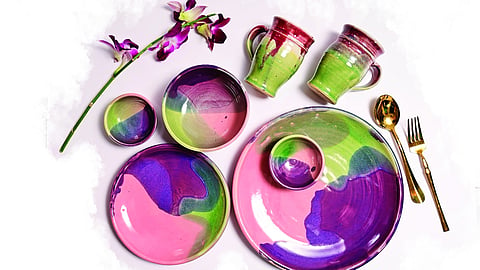
At Healing Pottery, founder Portarasan Subban’s relationship with clay is more personal. His Chennai-based creative space creates modern ceramic sculptures and functional objects, with the idea that healing begins with the process of making itself.
His connection to clay emerged during a difficult period in his life, when he felt unable to find a way forward. “It was clay that helped me come out of that phase and find myself again,” he says.
After nearly 25 years in the field, he has also witnessed how artworks can become part of people’s everyday lives, carrying an emotional connection beyond their function.
He hopes that when people take a Healing Pottery piece home, they take with them “a feeling and an experience”, along with happiness, peace and meaning. Craftepreneur 2026 exhibition will be held from September 10 to 12 at The Folly, Amethyst.