
- Chennai
- Tamil Nadu
- India
- World
- EntertainmentEntertainment
- Business
- Sports
- Lifestyle
- Technology
- Videos
- Explainers
- Editor's Picks

CHENNAI: What makes something common? A road, a public square, a song, a library or the internet can all be shared, but who gets to access them, shape them and decide how they are used? This is the larger question behind Porombokkiyal, which began as an attempt to challenge the way society defines knowledge and decides who gets to be called an expert. Now in its fourth edition, Chennai Kalai Theru Vizha’s day-long programme is expanding that conversation beyond land and natural resources to shared urban spaces and the internet.
The whole idea of Porombokkiyal was to platform different ideas of knowledge, different ways of gathering knowledge, of learning, of education and allowing people with these different knowledges to share their expertise with everybody,” says musician TM Krishna, who is moderating one of the sessions.
Earlier editions brought prawn pickers, grazers, fishers and tribal women from the hills into conversations about what they had learned from their childhoods, surroundings, occupations, cultures and music. Krishna says the intention was to invert a knowledge hierarchy that places university learning and mainstream education at the centre. “All of us presume that we are knowledge holders because of a certain social conditioning of how we believe we should learn or who knows,” he says.
For its fourth edition that will be held on September 19, Porombokkiyal moves this idea into the city. Krishna describes it not as a shift away from its earlier focus, but as an expansion of what the commons can mean in an urban environment. “For example, a road is a shared space, but people experience it differently. The programme asks who owns the road, how democratic it is and what it means to someone such as a woman auto driver who uses it as her workplace. A fish vendor’s experience also brings another question into focus: when shared urban spaces are redesigned or beautified, where does she fit into that idea of the city?” questions the musician.
The programme takes the idea of the commons beyond physical spaces to the internet, once imagined as an open and democratic space. “The idea of the internet was also about it being commons, being democratic and being there for everybody. How much of this really happens?” Krishna asks.
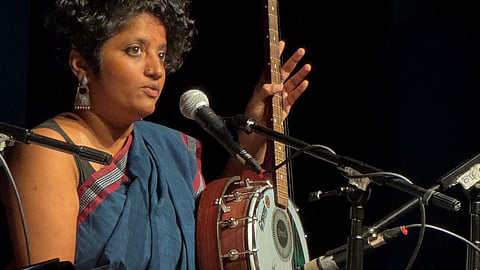
This forms the context for ‘Sharing Fairly: Music, Internet & the Ethics of the Commons’, which brings together singer-composer Bindhumalini, Ofro, founder of Atti Culture, and lawyer and IP specialist Swaroop Mami, with Krishna as moderator.
For Bindhumalini, music offers a way to examine how the idea of sharing works online. “I am interested to know this very disembodied way of music moving through different spaces,” she says, pointing to the way music can travel far beyond its geographical and generational roots.
She is also interested in what happens when listeners learn and pass on music they encounter online. “If anything we listen to becomes ours to process or to learn and to sing and then pass on, how do a rasika and an artiste navigate through this internet space?” she questions.
For an artiste, navigating these spaces also means negotiating questions of ownership and sharing. “As a musician, I am also trying to understand what I can claim, what I should acknowledge as belonging to someone else and how I can share and receive music responsibly,” she says. Bindhumalini hopes the discussion will open up questions around credit, ethics and responsible use of the internet, rather than offer easy answers.
Krishna believes younger audiences, particularly privileged younger people, are increasingly willing to question the assumption that knowledge has to come with a degree or institutional validation. “I think privileged younger people are far more aware of the world than we were at their age,” he tells us.
The internet and social media have brought their share of problems, but they have also created possibilities for people to encounter experiences and perspectives beyond their immediate surroundings. “These conversations now travel across continents, regions, race, colour and caste, making it possible for people to recognise knowledge outside the mainstream. And that allows for younger people to be more sensitive, to listen with more care and realise that everything that is learned within the mainstream is not the only thing that they need to learn or to enrich themselves from,” concludes Krishna.
Porombokkiyal 2026 will be held on September 19, from 10 am onwards at Trace The Space, Mylapore.