
- Chennai
- Tamil Nadu
- India
- World
- EntertainmentEntertainment
- Business
- Sports
- Lifestyle
- Technology
- Videos
- Explainers
- Editor's Picks

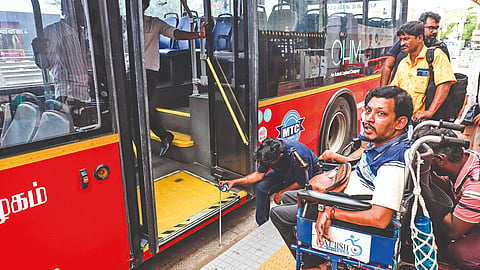
CHENNAI: Around 20 members of the Disability Rights Alliance (DRA), including 10 persons with ambulatory disabilities and four wheelchair users, on Sunday conducted a two-hour accessibility audit at the model bus stop near Vivekananda House on Kamarajar Salai to assess the ease of boarding and alighting from low-floor buses.
Officials from the Greater Chennai Corporation (GCC), Chennai Unified Metropolitan Transport Authority (CUMTA) and Metropolitan Transport Corporation (MTC) observed the exercise and received feedback from participants.
Wheelchair user and activist R Sathish Kumar said that the model bus stop had demonstrated that accessible boarding was possible if buses aligned properly with the kerb. “The footpath at this bus stop is 300 mm high, while the floor of the low-floor buses is around 400 mm from the road. When the bus kneels, the height reduces to around 260-280 mm. If the bus halts close to the kerb, wheelchair users can board independently,” he said.
However, activists pointed out that the gap between the bus ramp and the kerb remained a major safety concern. DRA member Gnana Bharathi, who uses a standard manual wheelchair, said that even a small gap could cause the wheelchair wheels to slip while boarding.
“I rely entirely on my upper body strength to board. If the bus does not stop close enough to the kerb, there is a real risk of the wheels slipping through the gap and causing a fall,” he said. “Rubber beading should be fitted along the edges of bus ramps to improve safety.”
The audit also highlighted inconsistencies in kerb heights across the city. While many bus stops have a height of around 150 mm, activists said the stop near MGR Janaki College has a kerb height of around 400 mm. They also pointed to the Saidapet Court bus stop, where the elevated kerb makes independent boarding difficult for persons with disabilities.
Sathish Kumar urged the GCC to standardise bus stop design by increasing the kerb height from 150 mm to 200 mm at future bus stops to improve accessibility.
Meekanshi Balasubramanian, a person with an ambulatory disability, said, “The tiles used at the model bus stop are slippery. The tactile paving has made it difficult to maintain balance while boarding and alighting. Using anti-skid tiles will make the bus stop safer for persons with mobility impairments.”
P Simmachandran, state president, Federation of TN Differently Abled Association, said that nearly 90% of wheelchair users depended on standard manual wheelchairs. “Even if they manage to board from a 150 mm-high bus stop, they cannot move inside the bus without assistance. Raising the height of bus stops is necessary to make boarding easier,” he said.
GCC officials said that the suggestions would be examined after disability rights groups submitted a detailed report.