
- Chennai
- Tamil Nadu
- India
- World
- EntertainmentEntertainment
- Business
- Sports
- Lifestyle
- Technology
- Videos
- Explainers
- Editor's Picks

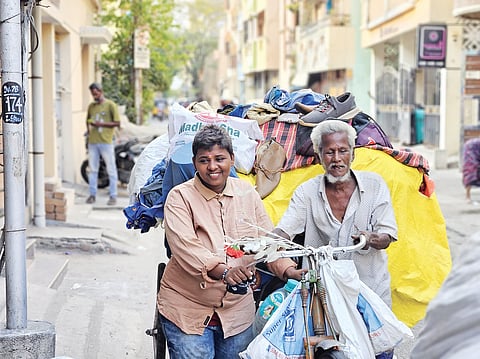
CHENNAI: Suresh Aarumugam (64) suddenly stood on the pedals, pushing harder as traffic piled up behind him. A couple of vehicles honked. He steered his tricycle, loaded with heavy wooden blocks, to the corner of the road and paused. “I get anxious. People don’t always horn, but I feel stressed thinking there is a jam because of me," he said.
Hailing from Virudhunagar, Aarumugam has spent the last 40 years in Chennai doing odd jobs. His tricycle is also, at times, his home. Move around Chennai, and there are still hundreds of such workers, most of them above 60, who rely on their bodies as the only fuel, not just to move, but to earn.
“I earn around Rs 300 if I cover 5 to 7 km. I can’t exactly pinpoint the distance-to-earning ratio,” he said. “If the goods are bulkier, they pay higher, and I can demand more.” By bulkier loads, he means around 80 to 100 kg, sometimes more.
“We try to take as much work as possible since work has shrunk,” said Kathiresan, another 64-year-old cart worker who now mostly takes scrap loads. “I am not able to take heavy loads anymore.”
This subsect of unorganised labourers, many of them in the last leg of their working lives, continues to pedal through scorching heat for meagre pay.
“Many have fitted engines in their cycles. They can carry more weight than we could, and this has left little space for us to negotiate,” they said.
“Fitting engine, lights, indicators and the basic setup costs around Rs 30,000. I finally managed it, but many cannot afford it,” said Ramesh (61). He has now stopped working altogether as earnings have dropped. “We used to bridge a Rs 1,000 difference between a tricycle and a minivan for short distances. Now, customers are not willing to pay even Rs 100 or Rs 200 extra for us.”
Many of them pedal for at least 12 hours a day, yet take home modest earnings. The only relatively organised stream of work is cylinder delivery, but even that offers limited relief. Gas agencies provide tricycles, and workers often carry 20 to 30 cylinders a day, earning around Rs 6,000 to Rs 8,000 a month.
“Our salary has not increased in the past three years,” said Selvakumar, who has been with the same agency for 16 years. Highlighting another issue, workers said, “Usually, there is a boundary of around 2 km. Beyond that, motor vehicles should deliver. But when there are more orders, we are made to go 4 to 5 km."
Cycle cart workers, despite being essential for last-mile logistics to date, often work under extreme distress without much potential to voice their concerns.
Even where alternatives like motorised or electric vehicles are discussed, affordability remains a barrier. With no capital investment in their current cycles, most continue with what they have.
Labour union representatives say the issue persists because it falls outside clear enforcement. “This is a grey area. There is no proper regulation on how far they should go, what they should be paid, or what support must be provided,” said Kuppusamy, one of the state secretaries of the Centre of Indian Trade Unions (CITU). “If the government takes a policy decision either to mandate support through agencies or provide subsidies for motorising these cycles, it can change their working conditions significantly.”
Several workers say small, targeted interventions could make a difference, particularly subsidies to retrofit tricycles with engines, or support routed through agencies that depend on their labour.
“If the government supports us, it will be helpful; we cannot protest like others,” Aarumugam said. “Kalaignar abolished hand-pulled rickshaws. In the same way, if something is given for us to set up engines, we can work our remaining years well.”