
- Chennai
- Tamil Nadu
- India
- World
- EntertainmentEntertainment
- Business
- Sports
- Lifestyle
- Technology
- Videos
- Explainers
- Editor's Picks
It was through the frames in Mani Ratnam’s films and the art of noticing in Vannadasan’s books that intrigued Chennai-based street photographer Muralikrishnan.
For Farah Sayyed from Singapore, what started as capturing landscapes and architecture soon shifted to the human side of places. Her lens began to focus on the relationship between a life being lived and the space holding it.
All these come to the limelight with the upcoming CPB International Open Call - Edition 2. Initiatives that create space for thoughtful visual storytelling have become increasingly significant.
The Chennai Photo Biennale Foundation, through the CPB International Open Call - Edition 2, attempts to nurture exactly such a space. “We always wanted to build an inclusive space to showcase the skills of photographers from across the world. Through that, we can discover new talents as well,” starts Varun Gupta, co-founder and director of CPB.

Over 9,400 photographs were submitted across the single image and photo stories categories from 37 countries, from which 110 photographers were selected by an international jury. “Unlike last time, we wanted to create a bigger space for the single image category in this edition. The quality has definitely gone up. It was tough for the jury to judge the remarkable conceptualisation. This time photographers were able to tell more kinds of stories. Moreover, the participation of Indian photographers has also increased,” he adds, explaining that the themes include climate change, personal narratives, culture, migration, isolation, and imagining the future.
Singapore, Netherlands, the USA, Bangladesh, Maldives, Germany, Italy, and Pakistan were among the participating countries. “Many lensmen realise their potential and start exploring opportunities with the exposure they get here,” Varun notes.
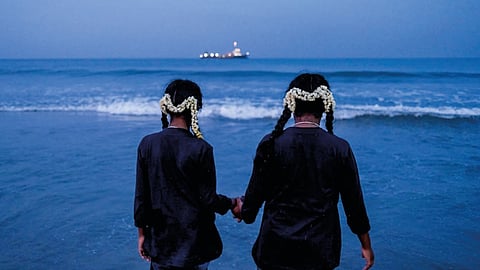
Muralikrishnan hustles between his regular job and his passion. He spends his weekends attending photo walks. Talking about his submission for the event, he explains, “I captured the moment when twin sisters were holding each other’s hands, facing the sea. That depicts how they will support each other as they step into the realities of adulting, which is symbolised by the vast and deep ocean.”
For Farah, the image has to evoke something in her first. “A pull or that quiet internal signal that says this is a story worth telling. The work I explore orbits around human moments like loneliness and belonging, the fleeting smile of a stranger, a person simply existing in their natural environment,” says the 38-year-old.
Elucidating how the cultural landscape of Singapore influences the way she frames stories, Farah shares that people have always been seeking their place and identity in Singapore. “Multiculturalism is practised daily, in the most ordinary and extraordinary ways. It has trained my eye to look for the layered, the textured, complex.”
Her submission, The Boy in the Window, was shot in a kampung in Indonesia. He was framed in a window, except there was no window, just an opening in the wall of his home.
The ethical weight burdened her. “Do I have the right to this image? And if I take it, what is my responsibility to him? No clear answer. But what I committed to, in that moment and in every image since, is this: to show the people I photograph in the best possible light, without subjugation, judgement, or disparagement.”
For many photographers, the concern is not just about the volume of images today, but about whether the artistic and narrative depth of photography is gradually being diluted by commercial pressures. “Instagram has become a saturation point for photography. Platforms like CPB help photographers like me validate, evaluate, and also recognise our skills,” states Muralikrishnan. Farah feels that for small photographers, without the backing of agencies or editorial machines, platforms like these are lifelines. “When a photographer living in Singapore stands beside work from Dhaka or Hamburg or Chennai itself, something shifts. You begin to see not just their world, but the edges of your own and how certain strands of these lives intersect. Without these spaces, many perspectives simply go unseen,” she adds. Head to Avtar Foundations for the Arts, MRC Nagar, on March 19 to immerse yourself in the confluence of themes. The exhibition is free of cost and will remain open until April 5.