
- Chennai
- Tamil Nadu
- India
- World
- EntertainmentEntertainment
- Business
- Sports
- Lifestyle
- Technology
- Videos
- Explainers
- Editor's Picks

CHENNAI: Marking World Autism Awareness Day, Sathish Sivakumar, head coach and founder of Yadhavi Sports Academy for Special Needs, chose to move beyond conventional awareness activities like walkathons and roadshows. Instead, he envisioned an initiative where children with autism could experience achievement first-hand, standing proud and confident in their own abilities. That thought led to the idea of an open sea swim.
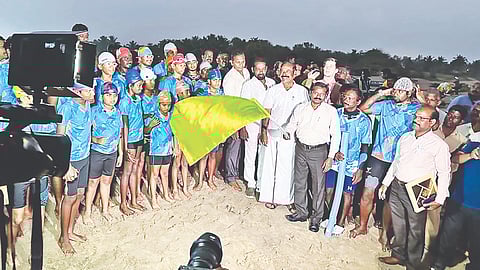
“In a powerful display of resilience, courage and inclusion, nearly 38 children with autism, along with their coaches, will participate in a 2-kilometre open sea swim on April 4 at Marina Beach. This is about showing that with the right support, they can achieve anything,” says Sathish. Children between the ages of 8 and 22 will take part in the event, with representatives from the Indian Book of Records expected to be present. “Such recognition is really supportive for the children,” he adds.
The academy provides structured training across multiple sports, with a strong emphasis on skill-building. “We have around 20 certified trainers for swimming. Apart from that, we also train children in basketball, handball and tennis. We conduct group activities like camps and beach clean-ups, and many of our children are already familiar with open water,” he explains.
For Sathish, training begins with understanding each child. “It’s not easy to teach swimming. First, we need to understand the child. Before any sport, we must build trust, communicate patiently and create a comfortable environment. Only when the child trusts the coach does learning begin. Some children learn quickly, while others take time.”
According to him, water has a unique impact on children with autism. “Because of their sensory needs, being in water helps them feel calm. We’ve seen clear behavioural changes among children, like better listening, improved focus and increased confidence after swimming.”
The approach, however, is never one-size-fits-all. “Every child is different, so the teaching method also has to be different. We have to customise our approach based on each child’s needs. As coaches, we must be patient and set individual goals. It’s important to focus on what each child truly needs.” The children train regularly in a swimming pool, with sessions in the ocean twice a week to prepare them for open water conditions.
Sathish, who has been working with children with special needs for over 13 years, has witnessed many of their journeys firsthand. “Some joined when they were eight and now they are 18. It’s fulfilling to see how far they’ve come.” He adds that children are often more perceptive than they are given credit for.
“They are very transparent. What matters is how we understand them. We also make sure they are physically fit at all times. My goal is for people to see them for who they are.”
Beyond the challenge of the swim, the initiative aims to shift perceptions. “This is not just about swimming. It is about acceptance, inclusion and giving every child the opportunity to shine,” Sathish points out.
Adding to the significance of the event, several participants were part of the 165-kilometre Cuddalore to Chennai sea swimming relay expedition in February 2024, highlighting the academy’s continued focus on long-term development and confidence-building.
For parents, the impact is deeply personal. Siva Shunmugam, father of 12-year-old Havish, enrolled his son in swimming in 2022. “He loves swimming, it’s like therapy for him. The coaches don’t push too much; they understand each child. We also focus on fitness and I try to connect my son with nature as much as possible,” he says.
Over time, the changes have been significant. “Earlier, my son had sleep disturbances. But after he started swimming and regular fitness activities, his routine improved. He is more disciplined now. It has become a habit over the past three years.”
He adds that children first build a rapport with their coaches, which becomes the foundation for learning. “Each child is different and the coaches know how to train them accordingly. There needs to be more awareness among people. These children deserve inclusion and the right to live fully.”
Echoing this, Sathish emphasises the importance of channeling their energy. “These children often have a lot of stamina. Swimming is a great way to use that energy positively, it’s both physically demanding and calming.”