
- Chennai
- Tamil Nadu
- India
- World
- EntertainmentEntertainment
- Business
- Sports
- Lifestyle
- Technology
- Videos
- Explainers
- Editor's Picks

CHENNAI: Chennai's first Bus Rapid Transit System (BRTS) is likely to come up along the 11-km Pallavaram-Thoraipakkam Road (PTR), with the Chennai Unified Metropolitan Transport Authority (CUMTA) seeking funding from the State government to undertake a feasibility study.
The move comes close on the heels of Chief Minister C Joseph Vijay recently reviving the long-pending proposal for a dedicated bus rapid transit network in the city.
This marks the first concrete step towards implementing a BRT corridor after the Chief Minister, during a recent transport department review meeting, asked officials to study South Korea's Bus Rapid Transit System as part of efforts to improve the speed and reliability of Chennai's bus network.
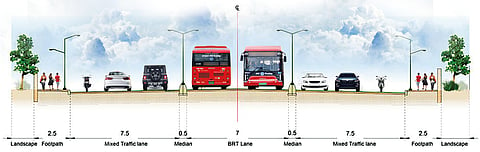
Officials said the Pallavaram-Thoraipakkam Road was identified because it offers one of the best opportunities to implement a BRT corridor. Unlike most arterial roads in the city that suffer from right-of-way constraints, the corridor has a 60-metre right of way, twice the minimum 30 metres generally required for a full-fledged BRT system.
CUMTA sources told DT Next that the authority intends to make the Pallavaram-Thoraipakkam corridor a model BRT project that can be replicated in other parts of Chennai if it proves successful.
The proposal is in line with the Comprehensive Mobility Plan (2023-2048) prepared by CUMTA, which recommended BRT corridors as part of its short and medium-term mobility strategy. The plan proposed corridors from Broadway to Poonamallee (23 km) and Neelankarai on East Coast Road to Pallavaram (12 km) in the short term, besides a 62-km corridor along the Outer Ring Road from Vandalur to Minjur in the medium term.
Officials, however, said the Broadway-Poonamallee corridor faces major implementation challenges because of inadequate road width.
"A BRTS requires a minimum right of way of about 30 metres. The Broadway-Koyambedu stretch has only about 21 metres at several locations, and becomes even narrower near Aminjikarai, making the implementation difficult," an official said.
The BRTS corridor requires a constant right-of-way of 30 metres for most of the section, accommodating two-way BRT plus two lanes for mixed traffic in each direction.
Apart from road width, officials said ensuring lane discipline would be critical for the success of any BRT corridor. They noted that while several Indian cities experimented with BRT systems, Ahmedabad remains one of the few successful examples.
"Our cities have a large number of two-wheelers and auto-rickshaws. Disciplined driving is essential for a successful BRT or bus priority corridor. In many cities, private vehicles frequently enter dedicated bus lanes during peak hours, affecting the efficiency of the system," a source said.
Urban mobility expert and ITDP India deputy director Sivasubramaniam Jayaraman, in a social media post, welcomed the Chief Minister's interest in the South Korean model, saying it reflected a positive shift towards prioritising buses.
A BRT system is much more than a dedicated bus lane, he said, explaining that it is an integrated public transport system with dedicated or priority corridors, modern stations, level boarding, intelligent traffic signalling, safer pedestrian access, efficient operations, and predictable journey times. Even where a full BRT is not feasible, bus priority lanes similar to those used in Singapore during peak hours could significantly improve bus speeds and reliability, Sivasubramaniam said.
However, investing in modern buses alone would not transform public transport unless buses were also given priority on roads through dedicated corridors and priority lanes, he added.
Buses remain the city's backbone, carrying more than 35 lakh passengers every day while also being the mode most affected by traffic congestion.
The renewed push also revives a project that was shelved after detailed planning. In 2019, Pallavan Transport Consultancy Services Limited (PTCSL) appointed ICRA Analytics Ltd to prepare a detailed project report for a 120-km BRT network across seven corridors. Although the DPR was completed, the proposal was subsequently dropped without implementation.