
- Chennai
- Tamil Nadu
- India
- World
- EntertainmentEntertainment
- Business
- Sports
- Lifestyle
- Technology
- Videos
- Explainers
- Editor's Picks
CHENNAI: Suburban train services on the Beach–Tambaram–Chengalpattu corridor have been reduced further from Tuesday, as Southern Railway leans on shuttle services to ease waiting time and manage rush.
The corridor, which handled around 204 services under normal operations, was first reduced to 164 when the Egmore platform block began on February 20. Now, regular services have been brought down to 115, with 26 shuttle trains introduced to partly compensate for the cut.
In the down direction, Chengalpattu-bound regular EMUs have reduced from 36 to 24, a drop of 12 services. In the up direction, services from Chengalpattu have fallen from 34 to 23, a reduction of 11 trains. Meanwhile, down services to Tambaram have declined from 32 to 27, while up services from Tambaram have dropped from 30 to 26.

To offset the reduction, Southern Railway has introduced 26 shuttle services between Egmore–St Thomas Mount and Guduvanchery–Chengalpattu, effectively adding back roughly 10 services in each direction towards the Chengalpattu side. However, all 26 shuttle trains bypass Nungambakkam and Kodambakkam, while most do not halt at Chetpet and Mambalam.
Railway officials said that this was intended to reduce overcrowding, and also provide faster movement for long-distance suburban passengers, but it left short-distance commuters within the city more dependent on the already reduced regular EMU services.
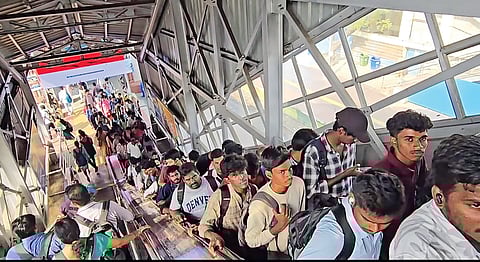
The disruption has now entered its fifth consecutive day, with heavy crowding reported at Tambaram and other railway stations. Passengers said trains were operating at 30-45 minute intervals, far longer than the announced 20-minute frequency, resulting in severe overcrowding and delays leaving thousands of office-goers, students and daily-wagers struggling to reach workplaces on time.
With public examinations scheduled in March, parents too expressed concern over student safety, noting that a large number of students depended on suburban trains. Some parents who purchased first-class monthly season tickets say overcrowding had rendered the distinction meaningless and sought relief measures during the 45-day disruption period.
Speaking to DT Next, MTC Managing Director T Prabhushankar said, “We’re pushing to the maximum and will try to extending services to ease commuter pressure, but it’s difficult to fill the gap as EMU services have strong patronage here.” Officials said 60 additional buses introduced across key routes are operating at full capacity.
The curtailment of EMU services has also pushed up ridership on Chennai Metro Rail. Commuters said Metro trains were witnessing unusual crowding during peak hours, with even parking facilities filling up quickly. “I’ve not seen this much rush along the Green Line during normal days. The Metro has been entirely packed,” said a commuter.
Daily passenger traffic has increased by around 20,000 since the reduction of EMU services from February 20. Metro stations with suburban connectivity including Alandur, St Thomas Mount and Airport have recorded an additional 2,000-3,000 passengers daily.
At Guindy Metro, ridership rose from 16,875 on February 16 to 18,867 on February 17, while overall Metro usage increased from 3.55 lakh on February 16 to 3.85 lakh on February 23. Chennai Central Metro station recorded one of the highest increases, rising from 31,690 on February 16 to 37,093 on February 23.