
- Chennai
- Tamil Nadu
- India
- World
- EntertainmentEntertainment
- Business
- Sports
- Lifestyle
- Technology
- Videos
- Explainers
- Editor's Picks

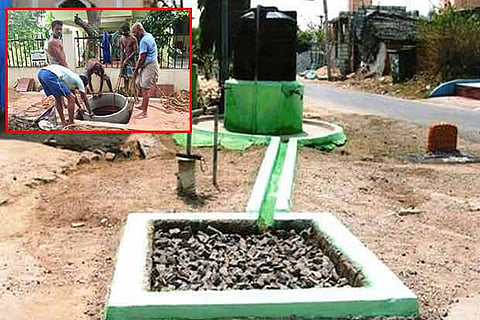
CHENNAI: To increase the average groundwater level in Chennai, the Greater Chennai Corporation (GCC) and the Chennai Metropolitan Water Supply and Sewerage Board (CMWSSB) have set an immediate goal of increasing the share of functional rainwater harvesting (RWH) systems from 30% to at least 70% across 10 lakh structurally feasible properties, said Corporation Commissioner GS Sameeran.
The GCC held a multi-stakeholder seminar on the functionality and necessity of RWH at Ripon Building on Thursday. Participants included representatives of Resident Welfare Associations (RWAs), the Confederation of Real Estate Developers' Associations of India (CREDAI), the Builders Association of India, CMWSSB, various GCC departments and technical NGOs. The programme follows the Chief Minister's launch of the RWH public movement "Thuli" on October 21.
Addressing the media during the meeting, Sameeran said that although the city is currently receiving sporadic heavy rain in this Super El Niño year, overall reservoir storage remains below expectations. On Thursday, the five reservoirs — Cholavaram, Poondi, Chembarambakkam, Redhills and Thervoy Kandigai — held 41% of their water, standing at 5.415 MCFT against a total capacity of 13.222 MCFT.
Chennai's daily drinking water requirement of 1,246 MLD is met largely by surface water from reservoirs (80%), followed by desalination plants (about 12%) and groundwater (6%). "We should aim to tap up to 10% from groundwater in the coming days," he said.
In a CMWSSB survey of 10 lakh properties, only six lakh properties were found to have functional RWH systems in the Greater Chennai Corporation limits. The GCC has a total of 17 lakh property owners, so about 13 lakh properties are structurally feasible for RWH. "Our immediate objective is to elevate functional RWH coverage from 30% to at least 70%," said the Corporation Commissioner.
Sameeran noted that over a building's 40 to 50-year lifetime, RWH structures may silt up within just three to four years. Maintenance requires only minimal cost for removing sludge, adding fresh sand or replacing cracked pipes. The Corporation is therefore educating residents and offering them technical handholding.
The GCC itself manages 1,858 public buildings, 1,003 parks and 87 playgrounds. Minor RWH defects found in its own buildings, including Ripon Building and Amma Maaligai, have been repaired, and self-audits are now under way across all 1,858 properties.
Summer-like weather is expected to set in after the North East Monsoon. Sameeran was optimistic that more spells of rain would improve storage, while minor repairs are in progress on networks and desalination lines.
"For new constructions, building completion certificates will be granted only after water-percolation tests confirm that the RWH system is functional," Sameeran added. The civic body is not penalising residents yet, but "will consider imposing fines after a review in six months," he said.