
- Chennai
- Tamil Nadu
- India
- World
- EntertainmentEntertainment
- Business
- Sports
- Lifestyle
- Technology
- Videos
- Explainers
- Editor's Picks

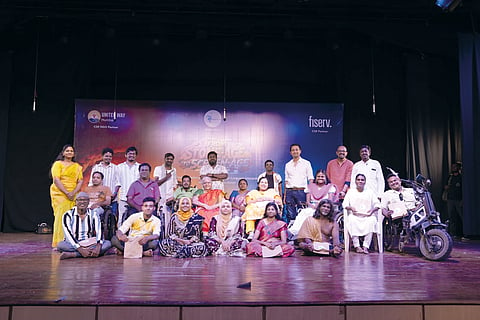
CHENNAI: Theatre became a celebration of inclusion at the Tapovan Hall of Chinmaya Heritage Centre on Harrington Road, where performers with diverse disabilities came together to present 'From Stone Age to Screen Age'. Blending humour, social reflection and physical storytelling, the play traces the evolution of communication and entertainment, from the stone age to the age of artificial intelligence.
The performance was a curtain-raiser ahead of a significant milestone for Chennai-based YWTC (Yes, We Too Can) Charitable Trust. The production has been selected for Bharat Rang Mahotsav 2027, organised by the National School of Drama (NSD). Recognised as the world's largest international theatre festival, the event will see the troupe travel to New Delhi in February 2027 to stage the play.
For YWTC founder-president Madhavi Latha Prathigudupu, the journey towards inclusive theatre began with a concern about the lack of representation of persons with disabilities in mainstream media. "The participation of persons with disabilities in mainstream media was almost zero. We wanted to understand why this was happening and what was preventing them from entering these fields," she says.
She explained that several misconceptions within the industry contribute to this lack of representation. "There is a general perception that persons with disabilities cannot perform certain roles or that their presence on screen may not be entertaining enough. There are also concerns that they may not have the necessary training and exposure and that investing time in training them may not lead to commercial success. We wanted to challenge these assumptions. Instead of waiting for opportunities to come their way, we decided to provide the training and create a platform where they could demonstrate their abilities," Madhavi adds.
With support from corporate CSR partner Fiserv, YWTC collaborated with the Film and Television Institute of India (FTII), Pune, to introduce training programmes in filmmaking, screenplay writing, acting, editing, smartphone filmmaking and direction. "We wanted participants to understand different aspects of filmmaking and acquire practical skills. It was important for us to provide them with proper exposure and professional training so that they could explore opportunities in the industry," she tells us.
The initiative subsequently expanded into theatre. Madhavi Latha approached the National School of Drama in New Delhi, following which a faculty member was deputed to conduct a theatre workshop for the participants. However, finding suitable venues proved to be another major challenge. While the group initially struggled to find auditoriums with accessible stages and green rooms, the trust was determined that its members should participate not merely as audience members but as performers.
"We have been searching for disability-friendly auditoriums for a long time. Initially, we were looking at accessibility from the perspective of audience members. But now, we are not looking at going to a venue simply to watch a performance. We are going there as performers. That requires accessible stages, green rooms and other facilities. Unfortunately, many auditoriums do not have these provisions. Finding a suitable venue was one of our biggest challenges," Madhavi shares.
The November 24 performance at Tapovan Hall was designed with accessibility at its core. The venue offered ramp access, accessible green rooms and barrier-free seating. The production brought together artists with diverse disabilities, including visual, hearing, mobility-related and neurodivergent conditions. Sign language interpretation was incorporated throughout rehearsals and the final performance to facilitate communication and participation.
“We wanted the entire experience to be inclusive, not just the performance on stage. We also had an audio description facility for audience members with visual impairments. Before the play began, we took visually impaired audience members to the stage and explained its layout, where the artists would enter, the different props being used and how the performance would unfold. This helped them understand and visualise the space,” explains Madhavi.
For Madhavi Latha, the transformation she has witnessed among the participants has been one of the most rewarding aspects of the initiative. "Theatre transforms people in unimaginable ways. Many participants came in with shyness and apprehension, but their confidence has grown tremendously. When they rehearse together, perform together and support one another, they develop a sense of belonging. That confidence will continue to reflect in other aspects of their lives as well," she opines.
"Another important outcome is the empathy and compassion they develop towards one another. When people with different disabilities come together, they begin to understand each other's challenges and requirements. They learn how to support one another. It creates a stronger sense of connection and also helps build disability awareness among everyone involved.”
The experience has also been significant for R Sathish Kumar, one of the participants, who has been passionate about acting and theatre. Having previously attended acting and dubbing courses, along with a 10-day theatre workshop, he said the November 24 show was his third theatrical performance this year. For Sathish, being part of an inclusive ensemble has been particularly meaningful. He pointed out that performers with hearing, visual and locomotor disabilities worked together, supporting one another during rehearsals and performances.
"Everyone supported each other with daily activities and during practice sessions. We rehearsed every evening for the last 10 days, with full-day sessions during weekends. It was a wonderful experience working together as an inclusive group," Sathish recalls.
However, he identified the lack of accessible infrastructure as one of the biggest obstacles faced by performers with disabilities. "Finding accessible spaces for rehearsals has been extremely difficult. Many halls and auditoriums do not have properly designed ramps or accessible toilets. Even when toilets are spacious inside, the doorways are often too narrow for wheelchairs, or there are steps that make access difficult. Finding venues with universal accessibility continues to be a major challenge," he tells us.
An aspiring theatre and film artist, Sathish also hopes to challenge the limited roles traditionally offered to persons with disabilities on screen. "A person with a disability should not be restricted to playing only a character with a disability. They can play a doctor, a teacher, a brother or a friend. A person using a wheelchair can also portray a doctor or another professional in a film. They do not necessarily have to walk or perform physically demanding actions to play such roles. They can deliver dialogue and portray characters just like anyone else," he adds.