
- Chennai
- Tamil Nadu
- India
- World
- EntertainmentEntertainment
- Business
- Sports
- Lifestyle
- Technology
- Videos
- Explainers
- Editor's Picks

CHENNAI: The Union Ministry of Environment, Forest and Climate Change has notified the Solid Waste Management Rules, 2026, which came into force on April 1 (Wednesday), following directions from the Supreme Court. However, implementation on the ground, particularly by the Greater Chennai Corporation (GCC), continues to lag, with source segregation yet to be effectively enforced.
The new framework replaces the earlier rules and seeks to tighten compliance, improve segregation and introduce accountability in the waste management chain.
A key feature of the revised rules is the mandatory fourstream segregation of waste at source. Households and establishments are now required to classify waste into wet, dry, sanitary and domestic hazardous categories.
While this system is expected to streamline waste processing and reduce landfill burden, civic bodies across urban areas, including Chennai, are struggling to ensure compliance. Despite the requirement being in place for several years, segregation remains largely ineffective in practice.
The new rules also introduce several structural changes, including the Extended Bulk Waste Generator Responsibility (EBWGR), the creation of buffer zones around waste processing facilities and the rollout of a centralised online portal to monitor waste management activities. These measures aim to improve transparency, accountability and efficiency. However, civic enforcement mechanisms have not kept pace with it.
Following the court’s directive, the Central Pollution Control Board has framed guidelines for environmental compensation based on the ‘Polluter Pays’ principle. Under these norms, state pollution control boards are empowered to impose penalties on entities that violate rules, including those operating without authorisation, submitting false reports or failing to manage waste properly.
The rules lay out clear guidelines for handling each category of waste. Wet waste, such as kitchen refuse, vegetable and fruit peels, meat and flowers, is to be composted or processed through bio-methanation at the nearest facility.
Dry waste, including plastic, paper, metal, glass, wood and rubber, is to be transported to Material Recovery Facilities for sorting and recycling. Sanitary waste, comprising items such as diapers, sanitary napkins, tampons and condoms, must be securely wrapped and stored separately.
Domestic hazardous waste, such as paint cans, bulbs, mercury thermometers and expired medicines, must be collected by authorised agencies or deposited at designated centres.
DK Chythenyen, senior researcher, Centre for Financial Accountability,
said, “The waste must be treated using appropriate technologies suited to each category.” He pointed to shortcomings in the Chennai Climate Action Plan, noting that its “performance indicators place equal emphasis on landfill disposal and decentralised waste processing. Waste-to-energy projects run counter to the principles of the revised rules and should be reconsidered.”
Data from the Tamil Nadu Pollution Control Board show that the State generates 16,563 tonnes of solid waste per day, of which 16,443 tonnes are collected. Of this, 9,303 tonnes are treated, while 7,260 tonnes continue to be dumped in landfills, highlighting the scale of the challenge.
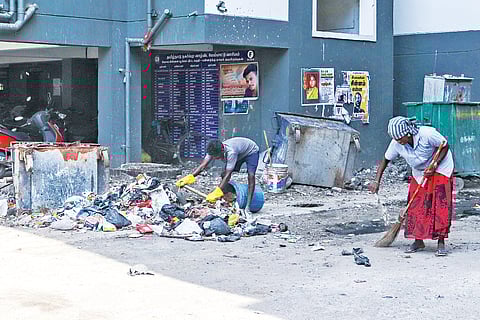
In Chennai, the Corporation workers collect between 6,150 and 6,300 tonnes of waste daily. Cleanliness workers remain at the forefront of the city’s waste management system but continue to face operational challenges.
P Srinivasalu, Madras Red Flag Union, explained, “The GCC faces a shortage of workers for both segregation and door-to-door collection. Waste collected at the household is first taken to unit-level collection points, then moved to secondary collection centres before being transported to dump yards.”
A sanitation worker in Tondiarpet said residents rarely segregate waste at source, forcing workers to manually separate mixed waste, often without adequate protective equipment. “Each battery-operated vehicle is required to collect at least 100 kg of waste daily, which typically involves covering more than 400 households. In many cases, even when residents attempt segregation, the lack of proper systems results in waste being mixed during collection,” he added.
The revised rules also mandate buffer zones for waste processing facilities handling more than 5 tonnes per day. The introduction of a centralised digital portal is expected to streamline registration, reporting and auditing processes, replacing manual systems with real-time tracking and improved oversight.
Local bodies are required to strengthen Material Recovery Facilities, which serve as hubs for sorting recyclable and non-recyclable waste streams, including e-waste and sanitary waste. The rules also encourage municipalities to explore carbon credit generation as part of sustainable waste management practices.
Another significant provision relates to the use of Refuse Derived Fuel, which is produced from non-recyclable waste. Industrial units, including cement plants and waste-to-energy facilities, are required to gradually increase their use of such fuel, with substitution targets rising from 5-15% over the next 6 years.
A senior Corporation official said the new rules would be implemented only “after formal orders are issued by the Municipal Administration department to local bodies across the State”.