
- Chennai
- Tamil Nadu
- India
- World
- EntertainmentEntertainment
- Business
- Sports
- Lifestyle
- Technology
- Videos
- Explainers
- Editor's Picks

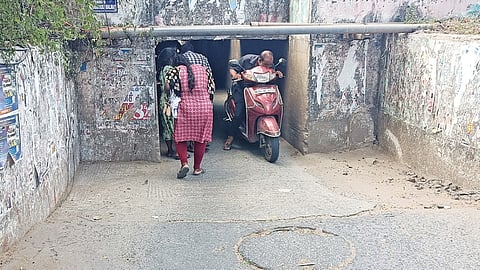
CHENNAI: A low-height railway culvert connecting Poleri Amman Koil Street and AA Road with Perambur High Road in Perambur has emerged as a safety concern, with pedestrians alleging that frequent movement of two-wheelers through the narrow passage has made it increasingly hazardous for daily users.
The culvert is widely used by residents of Arundathi Nagar as a shortcut to access Vyasarpadi Jeeva Railway Station, the BB Road bus stop, and several government and private schools in the locality. Residents said the passage, though not officially designated for public use, has become an important pedestrian link over the years.
However, the growing number of two-wheelers using the culvert has created difficulties for pedestrians, particularly during peak hours. Residents said the narrow width of the passage leaves little space for people to walk safely when vehicles approach from the opposite direction.
Meena, a resident of the area, said women, school students and senior citizens frequently use the route. "As the passage is narrow, the movement of vehicles from the opposite direction increases the risk of accidents. Some two-wheeler riders also hit their heads on the structure because they fail to notice the low-height clearance," she said.
Pointing out that the culvert was designed as a waterway to drain rainwater from the railway track area, Railway officials said neither pedestrians nor vehicles are officially permitted to use this route
Residents said the restricted headroom forces some riders to bend while passing through the culvert. They alleged that a few minor accidents have already occurred at the location due to the low clearance and the unsafe use of the passage by vehicles.
Many pedestrians have urged authorities to take measures to prevent the entry of two-wheelers into the culvert and improve safety for those who depend on the route for daily commuting.
Railway officials, however, clarified that the structure was not intended for pedestrian or vehicular movement. "The culvert was originally constructed as a waterway to drain rainwater from the railway track area. It was designed only for the passage of water, and neither pedestrians nor vehicles are officially permitted to use this route," officials said.