
- Chennai
- Tamil Nadu
- India
- World
- EntertainmentEntertainment
- Business
- Sports
- Lifestyle
- Technology
- Videos
- Explainers
- Editor's Picks

CHENNAI: For more than two months, several night shelters run by the Greater Chennai Corporation (GCC) have remained neglected, exposing persistent gaps in the city’s response to homelessness. Closed hospital-attendant shelters, inadequate facilities and the absence of shelters for men with disability point to the need for a comprehensive policy framework that goes beyond temporary sheltering.
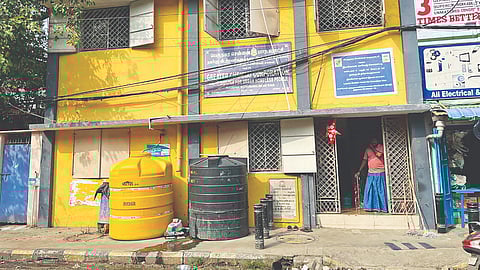
A visit by the DT Next team to multiple shelters found that night shelters for men on Pasumpon Muthuramalinga Thevar Road in Nandanam and Mandaveli Market Street in Mandaveli require urgent attention. The women attendants’ night shelter at Rajiv Gandhi Government General Hospital (RGGGH) was found closed, while the men’s attendants’ shelter at Government Kasturba Gandhi Hospital for Women and Children has remained shut for over two months.
From Devarajan Street, Triplicane, homeless elderly were shifted to other locations, but the shelter board remains in place. Most of these shelters can accommodate 30-50 persons.
The GCC operates 50 night shelters across Chennai under the Shelter for Urban Homeless (SUH) scheme, with NGOs managing daily operations. Royapuram zone has the highest with 14 shelters, followed by Teynampet with 9.
The civic body runs 9 women’s shelters, 13 men’s shelters, 2 shelters for girls and 4 for boys. There are also shelters for persons with psychological disabilities (two for women and three for men), 6 special shelters each for men and women, 3 shelters for the elderly, 1 shelter for women with disabilities and 1 for trans persons.
Despite this spread, major gaps persist. There is no dedicated shelter for physically disabled men in the city, leaving many to sleep on pavements and roadsides without access to facilities designed for their needs. Shelter coordinators said that they frequently encounter disabled men during rescue operations but have no specialised facility to accommodate them. Staff shortages have further disrupted services.
An in-charge staff member at the women’s shelter in Kasturba Gandhi Hospital said, “The men’s shelter here has been closed for over two months due to lack of staff, but the women’s shelter is open.”
At RGGGH, an attendant who has been using the night shelter for over a week said the facility accommodates up to 30 people, with higher occupancy at night. “Many new attendants coming to the hospital are now aware of the facility,” the person said.
The urban homeless shelter for elderly women on TTK Road at Kavignar Bharathidasan Salai is widely used. Similarly, the attendants’ night shelters for men and women at Kilpauk Medical College and Hospital have regular occupancy.
A coordinator there said that staff make nightly rounds to inform patient attendants about the facility. “The number of people staying fluctuates daily,” the coordinator said.
Infrastructure gaps continue to affect shelter usage. A worker at the men’s night shelter on Pasumpon Muthuramalinga Thevar Road said over 30 people can stay at a time, but there’s only one toilet. “Increasing the number of toilets and accommodation will help more people stay,” the worker said.
Shelter coordinators said that they frequently encounter disabled men during rescue operations but have no specialised facility to accommodate them. Staff shortages have further disrupted services.
As per a Supreme Court order, every urban local body must establish one night shelter for every one lakh population. Based on this norm, Chennai should have at least 84 shelters. However, only around 50 shelters are currently functional, indicating a significant shortfall.
The GCC’s standard operating procedures classify shelters into three categories: men’s shelters, women’s shelters and special shelters.
Men’s shelters are designed mainly for single working men, with a focus on accommodation, de-addiction services and rehabilitation. Women’s shelters aim to provide safe spaces for women and dependent children, including access to legal aid for survivors of abuse and support for economic independence.
Special shelters cater to vulnerable groups. These include hospital shelters for patient attendants, shelters for persons with mental illness or psychological challenges requiring specialised care, shelters for the disabled designed as per national accessibility standards, shelters for trans persons focusing on healthcare and social reintegration, and children’s shelters functioning as short-stay facilities with counselling and legal protection under the Juvenile Justice Act.
Under existing norms, men and women can stay in shelters for 3-4 months, and elderly persons, physically challenged individuals and trans persons can stay for 6-8 months, or until they complete treatment or rehabilitation.
Rescue operations are a key component of shelter functioning. A coordinator at a men’s shelter in Teynampet zone said that teams conduct rescue operations twice a week at beaches, bus stands and railway stations.
“The GCC schedules rescue dates, and the public can also use the Corporation’s helpline 1913 to report homeless persons,” the coordinator said.
Another coordinator in the same zone said those who come voluntarily can stay up to six months, while rescued persons usually stay for about a month. “Most are unskilled labourers. Based on their skills, we try to help them find jobs,” the coordinator added.
A September-2024 report by the Information and Resource Centre for the Deprived Urban Communities (IRCDUC) estimates that around 8,331 people are homeless in Chennai. Of these, 2,559 are individuals and 5,772 are members of homeless families. Among individual homeless persons, categories include migrants, non-migrants and those unwilling or unable to disclose details.
The report states that 95% of individuals who responded were from Chennai and neighbouring areas. Others could not be surveyed due to fear, mistrust or because they were asleep during enumeration.
The IRCDUC report categorised families into interstate migrants, intra-state migrants, nomadic tribes, families living on the streets for generations and those unwilling to disclose details. It found that 66% of homeless families have lived on the streets for generations.
The number of nomadic tribes is likely undercounted, particularly in areas such as Marina Beach, Besant Nagar Beach, Ambattur and near Vyasarpadi Jeeva station. While the GCC was among the first urban local bodies to establish a dedicated cell for Shelter for Urban Homeless (SUH), operational challenges persist.
Most shelters are designed for individuals, even though around 65% of Chennai’s homeless population lives as family units. Families often remain on pavements to protect their belongings or avoid separation. Experts say addressing homelessness requires a shift towards family shelters and integrated rental housing models to ensure dignity and stability.
Vanessa Peter, founder of IRCDUC, said homelessness requires multiple, needs-based interventions. “Shelter is the first critical step, but socio-economic and psychosocial rehabilitation are equally essential,” she said. “A comprehensive policy framework applicable across Tamil Nadu is crucial to ensure coordinated service delivery across departments.”
A Corporation official said that the Buildings department has recently taken charge of night shelters and “a meeting was held with the commissioner to improve facilities”.
Repeated attempts to reach GCC commissioner J Kumaragurabaran did not receive a response.
Teams conduct rescue operations twice a week at beaches, bus stands and railway stations. The GCC schedules rescue dates, and the public can also use the Corporation’s helpline 1913 to report homeless persons
A coordinator at a men’s shelter in Teynampet zone