
- Chennai
- Tamil Nadu
- India
- World
- EntertainmentEntertainment
- Business
- Sports
- Lifestyle
- Technology
- Videos
- Explainers
- Editor's Picks
When the DMK’s students wing planned a protest demanding Minister D Sarathkumar's dismissal, over an alleged drugs related video from over 2 years ago, the police refused permission, citing a lack of the mandatory five days’ notice required under Section 41 of the Chennai City Police Act, 1888. Immediately, top DMK leaders condemned the police and the government, labelling the action undemocratic and a violation of human rights.
Defying the refusal, protestors assembled at the designated venue and shouted slogans before being detained in a wedding hall and later released that evening.
To understand this incident, one must examine the legal implications of laws governing meetings and processions, alongside the track record of various ruling parties over the last 70 years. Whether it is the Congress, DMK, or AIADMK, the policy of using Section 41 to curb opposition protests has remained virtually identical shifting only in the severity of the clampdown.
Whether it is Congress, DMK, or ADMK, the policy of using Section 41 to curb protests by the opposition has remained virtually identical shifting only in the severity of the clampdown
The Madras City Police Act, enacted in 1888, granted sweeping powers to the city police. Under Section 41, the Police Commissioner can regulate public meetings and processions.
Once a notification is issued under this provision, it remains valid for 15 days, and the government can extend it to 30 days. During this period, no group can hold a meeting or procession without prior permission from the Police Commissioner; violators face immediate arrest and imprisonment.
Similarly, the Criminal Procedure Code of 1898 empowered District Magistrates to ban assemblies. If five or more persons gather after a declaration under Section 144 CrPC, it is deemed an ‘unlawful assembly’, allowing authorities to physically remove, arrest, and jail the participants.
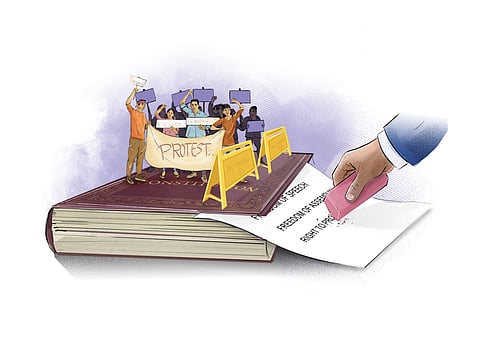
The message is clear: while in power, crush protests; when in opposition, cry foul over human rights. This hypocrisy must end if our fundamental rights are to mean anything after 75 years of the Republic.
When Prime Minister Jawaharlal Nehru visited Chennai in 1958, the DMK, led by Arignar Anna, decided to stage a black-flag demonstration protesting certain ‘uncivilised’ words Nehru had used in the Parliament.
Anna and 10 other leaders were arrested, jailed, and charge-sheeted before the Egmore Chief Metropolitan Magistrate for violating the ban imposed under Section 41.
Defending against the chargesheet, it was argued before the magistrate that Section 41 violated the constitutional rights to freedom of speech and assembly. Since the magistrate lacked the powers to adjudicate on whether a Section violated the Constitution, the case was referred to the Madras High Court under Article 395 of the CrPC for its opinion.
The High Court ruled that the Act was valid, and Anna, along with his partymen, was sentenced to prison. Ironically, within 10 years, the DMK came to power but continued to use this very provision. It remains a historical fact that the party routinely utilised the police to ban public meetings and processions.
Even after the DMK took office, the government continuously enforced the ban order under Section 41 through the Police Commissioner every 15 days without a break.
Since the Commissioner cannot enforce a ban for more than 15 days at a time, new reasons were cited each time an order lapsed to extend the restrictions, making it impossible to hold meetings or processions without explicit police permission.
In the early 1970s, labour organisations launched numerous agitations. Thousands of students, workers, teachers, and middle-class employees who defied the ban orders were arrested and sent to jail for 15 days. Trade unions spent half their time either securing bail or providing property sureties for detained members.
Even when the police did grant permission, they dictated the venues under the pretext of preventing inconvenience to commuters. Gradually, the police reduced the number of sanctioned meeting spaces in the entire city from five to just two. For processions, all main roads were declared out of bounds; if permission was granted, it was restricted to Langs Road in Chintadripet, abutting the Cooum River.
The Marina Beach (Kamaraj Salai) was made completely off-limits — except when Jallikattu protestors refused to disperse until their demands were met. Interestingly, it was a DMK government that had originally built a public meeting stage on Marina Beach using their voluntary service group, the Prosperity Brigade. Named Seerani Arangam, it was one of the city’s finest assembly grounds, echoing the times when Marina Beach served as a historic rallying point for freedom fighters.
However, when Jayalalithaa came to power, the first thing she did was demolish Seerani Arangam. Her subsequent attempt to remove the Kannagi statue was successfully thwarted, and the statue has since returned.
Police regulation was not restricted to public spaces; authorities even sought to regulate meetings held in private venues. An attempt to challenge the validity of Section 41 was rejected by the High Court in the late 1980s.
However, when P Nedumaran’s meeting was banned by the Commissioner, he moved the High Court. The High Court then made a very strong observation on the use of Section 41:
“The rights conferred on the citizens by Article 19 of the Constitution are precious and are not to be lightly breached or restricted by the State or any functionary of the State... The power to impose restrictions is not the power which is available for exercise in an arbitrary manner or for the purpose of promoting the interest of those in power, or for suppressing dissent. Democracy can be made dynamic and truly alive only when there is a free market for ideas and discussion and debate is not only permitted but is encouraged...The Madras City Police Act is a pre-Constitution enactment, and the powers conferred on the authorities at a time when the country was under the colonial regime and during the period when suppression of dissent was considered to be a legitimate policy of the State, cannot be exercised after the enactment of the Constitution in the same manner as it was exercised earlier.”
This observation by Justice R Jayasimha Babu in 1999 was later reiterated by a Division Bench. Consequently, the Madras High Court had to intervene in hundreds of cases involving the denial of permission for meetings and processions during the successive regimes of MGR, Jayalalithaa, and Kalaignar.
The political message across eras has been clear: “While I am in power, there shall be no protests; but when I am in the opposition, I will cry foul over the denial of human rights and the suppression of dissent.”
Ultimately, this hypocrisy must end. A true democracy must safeguard the legitimate values of freedom of expression and the right to dissent. As our Republic completes 75 years with a written Constitution that guarantees the rights to expression, demonstration, and assembly as fundamental rights, the right to protest cannot remain a mere proposition on paper.
(The writer is a former judge of Madras High Court)
