
- Chennai
- Tamil Nadu
- India
- World
- EntertainmentEntertainment
- Business
- Sports
- Lifestyle
- Technology
- Videos
- Explainers
- Editor's Picks

CHENNAI: Until the age of 10, Marapachi dolls were the constant companions of Uma Maheswari A.
As an only child during those years, she filled her world with these traditional wooden dolls, engaging in conversations, storytelling and imaginative exploration.
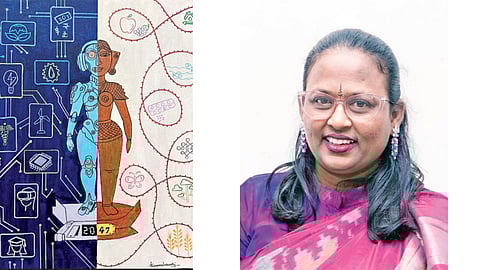
That deep childhood bond has stayed with her, eventually shaping her artistic journey. Today, through her work, Uma revives the traditional Marapachi dolls of South India, translating their sculptural geometry into a contemporary visual language while preserving their cultural essence. Along with her daughter Reya V and artist Dhenuka Nandhu, she will present her works at an exhibition titled Echoes of Form.
A multidisciplinary artist and founder of the Flying Rainbow Creative Art Centre, Uma says Marapachi dolls remain her favourite subject. “I’ve always been fascinated by dolls and toys, but Marapachi is what I connected with deeply as a child. I was an only child till 10, so these dolls became my companions. I had endless conversations and explorations with them. The form of any Marapachi doll would always remain the same, yet my imagination kept changing,” she says.
She points out that traditional Marapachi dolls follow a largely uniform design, with only slight variations. “That’s the beauty of it. The form stays constant, but you personalise it: through clothing, decoration, colour and texture. It encourages creativity and allows you to make it your own,” she explains.
The dolls also hold cultural and traditional significance in South Indian households. “There is no Golu without a Marapachi doll. It is the first doll placed on the steps. Many families still preserve Marapachi dolls that are over 100 to 150 years old, passing them down through generations,” she says. Traditionally made from red sandalwood, the dolls were also believed to have medicinal value. “In earlier times, if there was a minor burn or scar, people would grind a bit of the wood and apply it; it was considered healing,” she adds.
Uma says her personal connection is what drew her back to the subject. “If you ask children today about Marapachi, many may not know it. They know Minecraft, but not Marapachi! Through my art, I want to change that,” the artist says.
Her 16-year-old daughter Reya, who is also part of the exhibition, has a different artistic inclination. “She loves travelling and nature, so her work reflects scenic beauty. She’s still exploring her niche, experimenting with portraits, colours and textures,” Uma shares.
Dhenuka Nandhu, another participating artist, is an architect and researcher whose work explores symbolic pattern systems and inner structures. “My work focuses on symbol, rhythm and form. This is my debut exhibition. I work with pencil drawings and mixed media and my process is slow, intuitive and meditative, allowing forms to emerge through repetition and concentration,” she explains.
The exhibition will open on April 24 at 4 pm at the Kadambari Art Gallery, DakshinaChitra Museum, and will be on view until May 4.