
- Chennai
- Tamil Nadu
- India
- World
- EntertainmentEntertainment
- Business
- Sports
- Lifestyle
- Technology
- Videos
- Explainers
- Editor's Picks

CHENNAI: While 61 per cent of Chennai residents live within walking distance of some mode of public transport services, only 36 per cent currently have access to frequent bus services, according to a transit accessibility assessment released by the Metropolitan Transport Corporation (MTC) on Thursday.
The ‘People Near Transit’ (PNT) analysis, prepared with technical support from the Institute for Transportation and Development Policy (ITDP) India, assessed public transport accessibility across the Chennai Metropolitan Area (CMA) and identified areas requiring improvements in connectivity and service coverage.
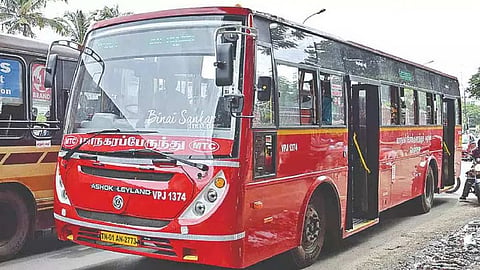
The Metropolitan Transport Corporation, which operates bus services across nearly 3,929 sq km in the CMA, runs services on 687 routes and carries around 35.31 lakh passengers daily. Along with Chennai Metro Rail and the suburban railway network, the city's public transport system currently provides walkable access to transit services for 61 per cent of the population.
According to the study, MTC's bus network forms the backbone of the city's public transport system, accounting for 56.5 per cent population coverage. The assessment defines PNT as the proportion of residents living within a walkable distance of public transport and uses the metric to evaluate how effectively transit services reach urban populations.
The report noted that 36 per cent of Chennai's population currently has access to frequent bus services. MTC considers routes with services operating at intervals of five minutes or less as high-frequency corridors. The assessment also found that 44 per cent of employment centres and 52 per cent of schools in the city are located within the catchment area of frequent bus services.
As part of the exercise, seven localities, including Ambattur, Sholinganallur, Kolathur, Perambur, Villivakkam, Maduravoyal, and Anna Nagar, were identified as priority areas where targeted interventions could significantly improve transit accessibility.
The report said Chennai has a relatively strong public transport foundation but highlighted opportunities to strengthen first and last-mile connectivity and expand access to frequent services. It also pointed to Chennai Metro Rail Phase II as a major opportunity to improve accessibility, projecting that Metro coverage could increase from the current 9.5 per cent of the population to 23 per cent upon completion of the project.
Based on the findings, MTC has proposed deploying 520 mini buses as feeder services to connect residential neighbourhoods with Metro stations and major transit corridors. It also plans to expand its school bus scheme as part of efforts to improve mobility options for students.
61% of residents live within walking distance of public transport
56.5% covered by the MTC bus network
36% currently have access to frequent bus services
MTC defines frequent services as routes with 44% of employment centres fall within the catchment area of frequent bus services
52% of schools are located within the frequent bus transit shed
Metro coverage currently reaches 9.5% of Chennai's population
Metro coverage is projected to increase to 23% after completion of Phase II
Seven priority zones identified: Ambattur, Sholinganallur, Kolathur, Perambur, Villivakkam, Maduravoyal and Anna Nagar
MTC plans to deploy 520 mini buses as feeder services to improve last-mile connectivity
The corporation also proposes expansion of its school bus scheme
Operational area: 3,929 sq km
Bus routes operated: 687
Daily ridership: 35.31 lakh passengers