
- Chennai
- Tamil Nadu
- India
- World
- EntertainmentEntertainment
- Business
- Sports
- Lifestyle
- Technology
- Videos
- Explainers
- Editor's Picks
Setting aside an emergency fund is a crucial part of your financial plan, but figuring out the ideal place to store it can be challenging as your savings mount up. You want ready access to the money for unplanned expenses, but you also don’t want to miss out on the interest it could earn.
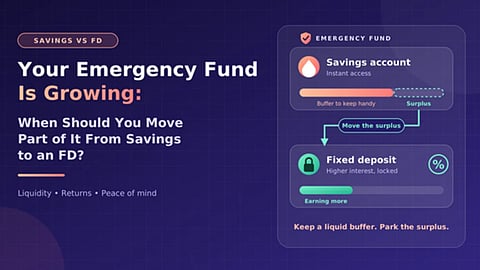
A savings account keeps your money easily accessible for unexpected expenses, although it may offer relatively modest interest. Fixed deposits (FDs), on the other hand, may offer higher, predictable returns for a specified tenure. However, premature withdrawals may attract penalties or result in reduced interest, depending on the bank’s terms and conditions.
Moving all your savings into an FD may not be practical. Instead, keep enough money readily available and consider moving the surplus into an emergency fund FD. Your monthly expenses, income stability and withdrawal conditions can help you decide how much to move.
In general, the savings should be sufficient to cover three to six months of basic expenses. Your income stability, family responsibilities, insurance coverage and financial commitments will determine the appropriate amount.
When assessing how much emergency fund to keep in savings account, consider the following:
● Immediate expenses: Maintain a reserve of the fund that allows you to cover urgent medical bills, essential repairs, insurance deductibles, and other payments that are not possible to defer.
● Loss of income: If at any point you happen to be laid off or one of your clients decides to drop you, this reserve should cover your expenses until your income resumes.
● Availability of funds: Consider whether you can transfer funds instantly at any time, including weekends and bank holidays.
● Family responsibilities: A family with dependants may require a larger immediately accessible balance than one where an individual has fewer financial commitments.
The savings account portion should reflect how quickly you might need the money, rather than a fixed percentage of your total balance.
A Fixed Deposit may suit the portion of your emergency fund you are unlikely to need immediately. However, prioritise easy access over higher returns, as premature withdrawals may attract penalties. Check your bank’s terms carefully before opening an FD to understand applicable charges and restrictions.
There is no fixed amount at which everyone should open an FD. A fixed deposit can hold part of your emergency fund, but only the part you are unlikely to need at short notice.
It may be a good option for you to move part of your emergency fund to an FD when:
● You have enough money saved to cover at least the planned number of months of essential expenses.
● Your bank balance is greater than the amount of cash you would probably need at once.
● Your job income is more or less dependable, and the expenses you expect to have are predictable.
● You understand the FD’s premature-withdrawal terms and are confident you can access money quickly if needed.
Say your monthly essentials come to ₹40,000 and your emergency fund stands at ₹3,00,000. A six-month reserve works out to ₹2,40,000, keep that in your savings account, and the remaining ₹60,000 can go into a short-term FD to earn extra interest.
Avoid keeping all your money in a long-term deposit account. You can instead create an FD ladder by putting your savings into fixed deposits of varying tenures. Doing so allows portions of your savings to become available to you at different times, which can give you some flexibility to meet your financial needs.
For instance, three-month and six-month deposits may serve different purposes. Check the bank's policy on the premature withdrawal of a fixed deposit. You can use an FD calculator to help you determine how much money you will get on maturity.
Before investing, check the bank's terms and deposit insurance coverage. The DICGC protects eligible deposits up to ₹5 lakh per depositor in each bank. Interest earned on a fixed deposit is also taxable. Always keep post-tax returns in mind when making decisions regarding emergency deposits.
In India, if you are looking to place an emergency fund FD, safety and accessibility should be the first priority over higher returns. Money meant for urgent expenses should never sit anywhere it takes days to reach.
After your regular expenses have been set aside, having an emergency fund FD might serve its purpose well. The basic idea is to have a balance between a readily accessible money store and the chance of making some interest, rather than just trying to get the highest returns at the same time.
You only need to keep the amount you need for unexpected or urgent expenses in your savings account and the rest can be moved into FDs. Keep on tracking this setup each time your earnings, daily expenses, or family responsibilities go through any sort of change. A well-structured emergency fund FD strategy will increase the usefulness of your savings without compromising its primary purpose, i.e., helping you manage unexpected expenses.
