
- Chennai
- Tamil Nadu
- India
- World
- EntertainmentEntertainment
- Business
- Sports
- Lifestyle
- Technology
- Videos
- Explainers
- Editor's Picks
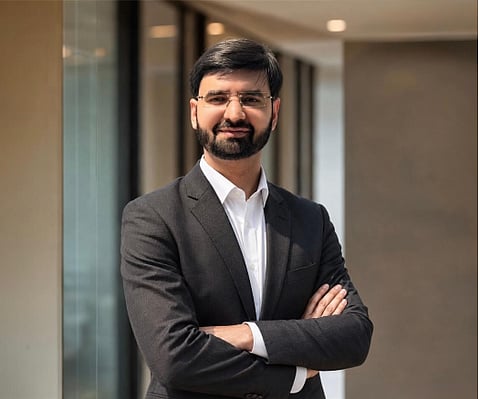
CHENNAI: Vatsal Soin is an Indian inventor and systems theorist whose work spans footwear fit systems, apparel interoperability, and governance architectures.
His 0→1 Doctrine is a proposed pre-execution governance framework and authorised intelligence architecture. It normalises measurable parameters to a bounded interval and evaluates them against authorised ranges before consequential actions occur.
The framework is intended to operate across domains in which requirements must be matched to capabilities, including healthcare, procurement, autonomous systems, and agentic AI. This interview focuses on the mathematical framework developed to describe and analyse the architecture.
You have described a set of theorems underlying the 0→1 Doctrine. What do those theorems actually prove?
They prove specific properties of the architecture within explicitly defined boundaries. The core properties are determinism, scale invariance, privacy preservation, and what I call constitutional completeness. Determinism means the same inputs always produce the same output. Scale invariance means the governance logic does not degrade as the number of users increases. Privacy preservation means raw data is proved never to travel through the system. Constitutional completeness means every governance case falls within a finite classification.
These are proved properties, not design aspirations. The proofs operate within explicitly stated scope and acknowledge what lies outside.
You have drawn parallels to Shannon, Turing, and Gödel. How precise are those comparisons?
They are structural analogies, not equivalence claims. Shannon reduced all communication to a universal measure — bits. The normalisation theorem in my framework reduces all governance parameters to a universal measure — a band between zero and one. The move is structurally similar: heterogeneous units become comparable through a common representation. I am not claiming the normalisation theorem is of comparable importance to Shannon’s work. I am observing that the architectural logic follows the same pattern.
The analogy is methodological, not a claim of equivalence in importance or scope.
The Turing parallel is more specific. Turing proved that no general algorithm can determine whether an arbitrary program halts. The deterministic closure proof in my framework does not challenge that result. It operates within a constitutionally bounded domain where all inputs are normalisable, all outputs are one of a finite set of defined states, and no arbitrary programs are involved. Within that specific boundary, termination is guaranteed. Outside that boundary, Turing’s result remains untouched.
The Gödel parallel concerns the boundary itself. Gödel proved that any sufficiently powerful formal system contains true statements it cannot prove internally. My framework constitutionally places certain decisions — those requiring human judgment — outside the computational system by design. This is not a limitation discovered after the fact.
It is a constitutional choice made before the system is built.
What are the limits of what the theorems prove?
Several important things are not claimed. The theorems do not prove that the normalisation choices made for any specific domain are correct — those choices require domain expertise and regulatory input.
They do not prove that the thresholds set for band overlap are optimal — thresholds are set by authorised bodies and refined iteratively. They do not prove that the system produces morally correct outcomes — the architecture operates in the technical domain only. Ethical judgment remains in the human oversight layer by constitutional design.
The closure theorems establish that every governance case falls within a finite classification. They do not close governance as a field. The boundary of the system is itself a human decision, and that boundary may expand as understanding evolves. What is proved inside the boundary does not change when the boundary expands.
The framework includes four lemmas supporting the scale invariance proof. Can you describe what those establish?
The four lemmas establish independence properties. The first establishes that each user’s normalisation is computed independently of every other user — no cross-user terms exist. The second establishes that the normalisation functions are invariant under the size of the user population — the function applied to one user is identical to the function applied at eight billion users. The third establishes that products and services are evaluated independently of each other. The fourth establishes that the order of evaluation does not affect the result.
Together these four properties mean the governance logic is identical at decision one and decision one billion. Scale affects throughput only.
The domain completeness theorems are compared to Peano’s axioms and Euclid’s postulates. Is that comparison defensible?
With qualifications, yes. Peano established a minimum complete set of axioms sufficient to derive the properties of natural numbers within a formal system. Euclid established a minimum complete set of five postulates sufficient to derive all plane geometry. The domain completeness theorems are presented as a minimum complete set sufficient to classify every governance decision within the doctrine’s formal domain. The qualification is important: Peano closed the natural number system as a formal system. Euclid closed plane geometry — not all geometry. The theorems close governance within the doctrine’s defined decision domain, not governance as a concept. That boundary distinction matters and must be stated explicitly.
Even if the mathematical claims are correct, what challenges would adoption face?
The architecture does not operate in a vacuum. Many of the parameters it governs already have established scientific, operational, or regulatory thresholds and ranges defined by adopted standards and regulatory frameworks. Where they do not, the architecture defers to authorised human judgment rather than resolving the question itself. Cross-jurisdictional deployment raises legal and institutional questions the architecture alone cannot resolve. The theorems describe properties of a formal system. Whether and how such a system is adopted remains a separate practical question.
What mathematical work remains to be done?
Several areas remain open. The framework does not address the optimality of normalisation choices within equivalence classes, nor does it model how the boundary between computable parameters and human judgment should evolve over time. It is accompanied by simulation evidence, implementation materials, and deployment models, indicating consideration beyond a purely theoretical construct. Questions of effectiveness at scale, regulatory acceptance, and broader adoption remain matters for real-world evaluation.
The proofs are presented as formal demonstrations of the claimed properties within their stated scope. Deployment introduces separate engineering considerations that the proofs do not address, and implementation outcomes depend on deployment choices and operational requirements.
Which thinkers have most influenced this work?
Shannon’s influence is direct. He identified a problem that resisted precise formulation, constructed a formal mathematical structure to represent it, and derived results that held regardless of the specific medium. That methodological approach — find the invariant, prove it holds universally within a defined scope, acknowledge what lies outside — is what I have attempted to apply to governance. The influence is methodological rather than mathematical.
That debt is acknowledged.
Conclusion
Across footwear, apparel, interoperability frameworks, and governance architectures, a recurring theme in Vatsal Soin's work is the relationship between requirements and capabilities — how different systems can interact accurately and responsibly before consequential actions occur.
Editor's Note: Vatsal Soin is an Indian inventor and systems theorist whose work has focused on footwear, apparel, interoperability frameworks, and governance architectures.
