
- Chennai
- Tamil Nadu
- India
- World
- EntertainmentEntertainment
- Business
- Sports
- Lifestyle
- Technology
- Videos
- Explainers
- Editor's Picks

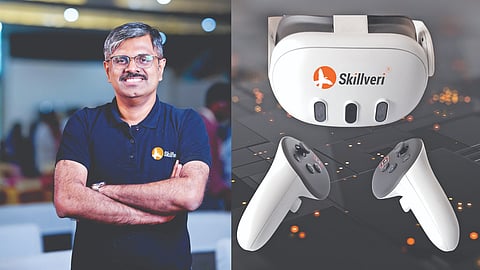
CHENNAI: A stroke survivor puts on a VR headset and, instead of mechanically repeating the same arm exercise, finds himself/herself reaching for objects, completing tasks and navigating an immersive environment. Every movement is tracked, measured and scored thus turning a mundane physiotherapy routine into something closer to a game.
That is the idea behind XTend, Skillveri’s VR-based software for post-stroke upper-limb rehabilitation, developed with the Sree Chitra Tirunal Institute for Medical Sciences and Technology (SCTIMST).
For Skillveri founder-CEO Sabarinath Nair, the connection between factory-floor training and stroke recovery was not immediately obvious. It emerged through IIT-Madras, when a mechanical engineer from SCTIMST, pursuing his PhD there, connected the two organisations. “Initially, we thought the medical field was not related to our work. But in the context of stroke rehabilitation, it is extremely relevant,” Nair told DT Next.
“When someone has a stroke, part of the brain is damaged, and other parts need to be trained or retrained to perform activities the person already knew. It is a skill they had but have forgotten, and they must revive it,” he said.
That could be particularly valuable in stroke recovery, where sustained participation is critical. Over 13 million strokes occur globally each year, with a large proportion of survivors experiencing upper-limb disability. Conventional rehabilitation is also heavily dependent on regular, in-person sessions.
XTend is designed to take some of that burden away from hospitals.
Skillveri’s expertise lies in hand-eye-mind coordination and precisely measuring physical movements. The same principle is now being applied to rehabilitation, with SCTIMST bringing the clinical expertise and Skillveri translating it into an immersive technology platform. An initial agreement was signed in May 2024, followed by a technology transfer agreement in May 2026.
XTend has over 19 immersive activities of daily living modules, covering movements from the shoulder to fingers. Its camera-based, markerless tracking eliminates wires and wearable sensors, while AI-driven adaptive difficulty can change exercises as a patient progresses.
The gamification is central to the proposition: patients are not merely told to repeat an exercise; they interact with a virtual environment, with each movement becoming part of a task. The system simultaneously generates data for the physiotherapist and doctor.
“In VR, we have to be particularly careful because if the solution is not designed well, it can create more problems than it solves,” Nair said. Skillveri also wants to tackle another problem of access. Instead of patients repeatedly travelling to hospitals, a physiotherapist could potentially carry the portable system to their homes. The company is exploring a phone-andTV version as a lower-cost alternative to VR headsets. “We have not finalised the cost yet, but we want to keep it affordable for the market,” Nair said.
Nair argues that the economics must include travel, caregiver time and lost wages. “In many cases, that person would be an earning member of the family, possibly the sole breadwinner,” he said.
The company has secured a CDSCO class A MD-13 test licence, been selected for the 2026 innovation session at the European Stroke Organisation Conference and filed a patent covering XTend’s tracking and adaptive rehabilitation algorithms.
The healthcare foray could become a significant growth engine for Skillveri, which counts Tata Motors and Indian Railways among its customers. The company expects to close the year at around Rs 10 crore revenue, targeting Rs 15 crore to Rs 20 crore next year, with an overseas contribution of roughly Rs 7 crore.
Nair believes healthcare could eventually overtake the core business. “You can choose not to take a course or learn a particular skill. But when someone is paralysed, they have to do whatever is possible to recover and get back to their normal life,” he said.
That perhaps sums up Skillveri’s approach to technology. “It is a tool. It is useful only if it solves a real-world problem,” Nair signed off.