
- Chennai
- Tamil Nadu
- India
- World
- EntertainmentEntertainment
- Business
- Sports
- Lifestyle
- Technology
- Videos
- Explainers
- Editor's Picks
NEW DELHI: Retail inflation surged to 6.09 per cent in October, breaching the Reserve Bank's upper tolerance limit for the first time in two years and prompting economists to anticipate a policy rate hike by the RBI next month.
The consumer price index (CPI) based retail inflation rose to 5.54 per cent in September, as a sustained uptick in food & beverages (F&B), restaurant services and transport inflation played a key role in pushing up the October headline number.
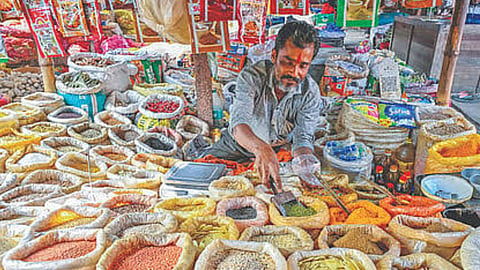
Data released by the Ministry of Statistics & Programme Implementation showed that food inflation spiked to 8.94 per cent in October from 7.74 per cent in the previous month.
Of the 12 categories, including food items and services, 11 showed hardening in inflation. Retail inflation in restaurant and accommodation services was 10.06 per cent, F&B was 8.51 per cent, and personal care and miscellaneous goods and services were at 10.14 per cent.
The top five items with high inflation were onion (116.22 per cent), garlic (60.74 per cent), silver jewellery (52.39 per cent), ginger (48.32 per cent) and lemon (47.30 per cent).
This is the first time in two years that retail inflation has breached the RBI's upper tolerance band of 6 per cent. The central bank is mandated to keep inflation within the range of 2-6 per cent. In October 2024, retail inflation was 6.25 per cent.
DBS Bank, Senior Economist and Executive Director, Radhika Rao, said the spike in October retail inflation was driven by a sharp rise in food inflation, accompanied by signs of broadening out of price pressures on a sequential basis.
"With headline inflation yet to peak, compounded by an unfavourable base effect, the central bank's quarterly projection is likely to be revised higher. The data reinforces our expectation of a second successive rate hike in December," Rao said.
The RBI hiked the benchmark policy rate by 0.25 per cent to 5.50 per cent in October, its first hike in nearly four years while signalling that further rate hikes could follow amid rising inflation, a weak rupee and high crude oil prices.
The October retail inflation is a key data point before the December 2-4 meeting of the RBI monetary policy committee.
Icra expects year-on-year inflation in the F&B segment to remain elevated above the 8 per cent mark in November 2026, similar to the print seen in October 2026, with upward pressure from prices of items such as milk, sugar and onions.
Moreover, the deficient monsoon and inadequate replenishment of reservoir levels have heightened concerns regarding the rabi crop outlook and food inflation.
"With the CPI inflation set to remain above the 6 per cent upper bound of the RBI’s tolerance band over the next couple of months, and GDP growth likely to ease only slightly in Q2 FY2027 relative to the previous quarter while remaining above the 7 per cent mark, a further 25 bps rate hike in December appears almost certain.
"Thereafter, the trajectory of crude oil prices, which have cooled in the recent sessions, will be critical in shaping the need for and extent of additional rate tightening in 2027," Icra Chief Economist Aditi Nayar said.
360 ONE Asset, Senior Economist, Vikram Chhabra said there are clear signs of broadening inflationary pressures, with higher energy and raw material costs passing through to core inflation.
In addition, food price inflation is picking up, with further upside risks stemming from the impact of weak reservoir levels on the rabi crop.
"Headline inflation is likely to stay above the RBI’s 6 per cent upper tolerance limit over the next few months. Against this backdrop, we expect another 25 bps rate hike, although the recent sharp correction in crude and rupee appreciation provides some breathing room to the RBI," Chhabra said.
PHDCCI SG and CEO Ranjeet Mehta said the October inflation reading underscores the importance of distinguishing between headline inflation and its underlying components.
"The increase in food inflation, alongside relatively moderate price increases in housing and health-related categories, reflects the uneven nature of price pressures across the consumption basket.
"Sustained moderation in food inflation would be important for improving household purchasing power and providing greater predictability to the monetary policy environment," Mehta said.
Knight Frank India, National Director Research, Vivek Rathi said that with the policy stance already hawkish, the possibility of a repo rate hike at the upcoming MPC meeting is apparent.
"The combined effect of elevated living costs and potentially higher borrowing rates could weigh on housing affordability, dampen homebuyer sentiment, and introduce some near-term tightness in the residential real estate market," Rathi said.